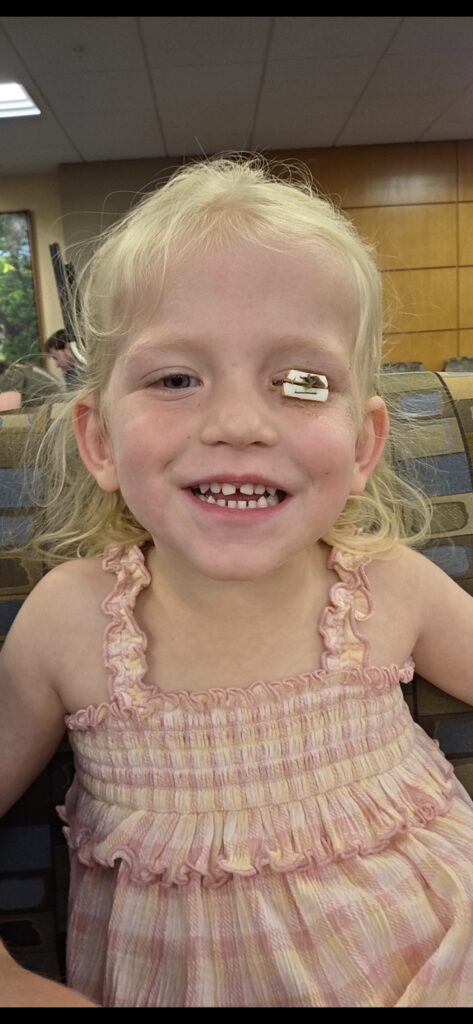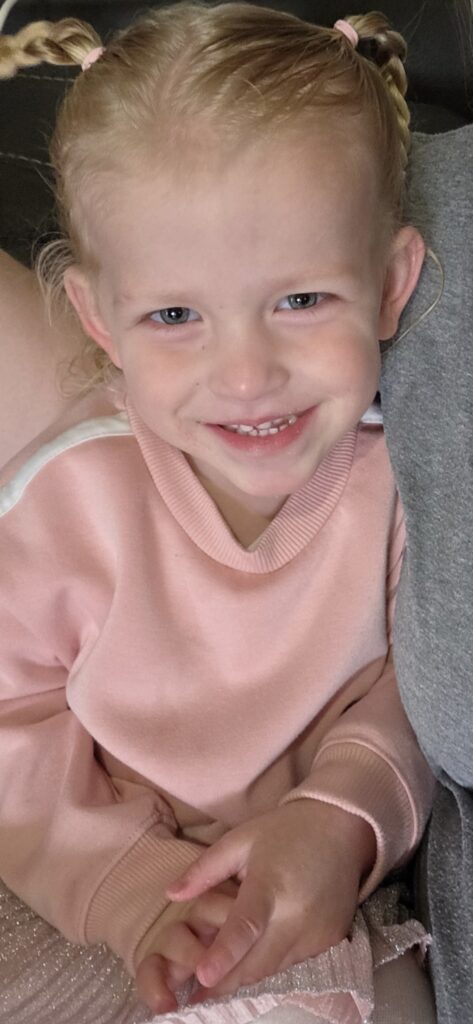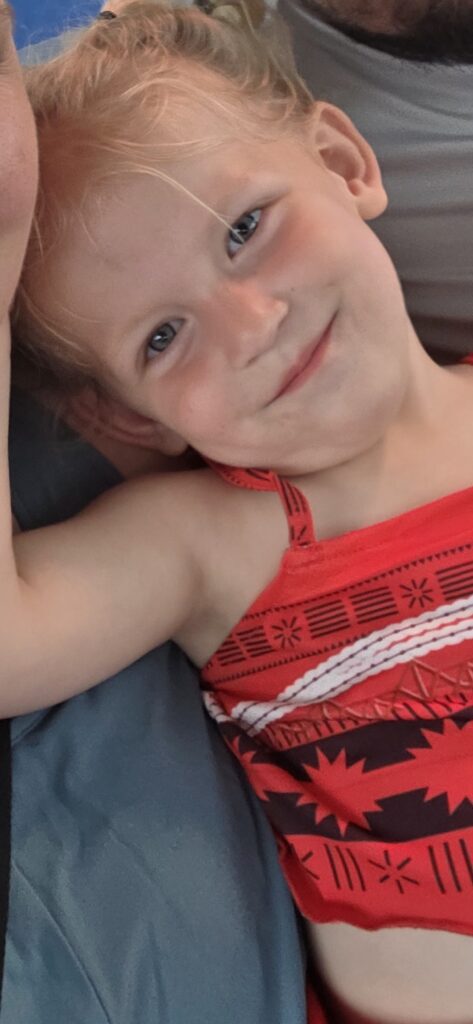
When Schyler Hutchinson recently reached out to KnowTheGlow to share the story of her two-year-old daughter, Taylor, she was not looking back on a journey that was already behind them. Her family is still very much in the midst of it.
KnowTheGlow Co-Founder Megan Webber spoke with Schyler as she shared the harrowing experience of watching her young daughter go through a retinoblastoma diagnosis, the loss of her right eye, repeated examinations under anesthesia, surgeries and genetic testing. Their conversation was also filled with the small details that remind you that, in the middle of all of this, Taylor is still simply a two-year-old little girl who wants to swim, play, eat snacks and be cuddled by her mom and dad.
Schyler told Megan that she first noticed a small white spot in Taylor’s eye in early June. At the time, she did not think something was terribly wrong. Taylor had been seen regularly by doctors, and after an earlier developmental screening prompted an eye examination, Schyler had been reassured that her daughter’s eyes looked healthy. She made a mental note to bring up the unusual reflection at Taylor’s next pediatric appointment.
Within weeks, everything changed. In early July, Taylor became sick. She was tired, had little appetite and began vomiting. Her parents initially thought she had picked up a stomach bug, but then one of her eyes became red and swollen. When the swelling worsened, Schyler, who was working that weekend, told her husband, Michael, to bring Taylor to the emergency department where Schyler could meet them.
Doctors initially worried about a serious infection around Taylor’s eye and sent the family to Mayo Clinic in Rochester for specialized care. There, a CT scan revealed something no parent expects to hear. Doctors were concerned that Taylor might have retinoblastoma, a rare childhood cancer of the eye. More testing would be necessary, but suddenly Schyler and Michael found themselves confronting the possibility that their little girl had cancer.
The days that followed were filled with hospital stays, imaging, specialists and examinations under anesthesia. Schyler and Michael were trying to absorb frightening new information while also comforting a two-year-old who could not possibly understand why so many people were examining her, why she was hurting or why she repeatedly had to be put to sleep for procedures.
An MRI confirmed a large mass in Taylor’s right eye. Although doctors were hopeful that the cancer had not extended into the optic nerve, the tumor had already caused extensive damage inside the eye. During a sedated examination, Taylor’s ophthalmologist was finally able to see the extent of the disease. The family learned that even if doctors attempted to save Taylor’s eye, she would have no useful vision in it and there was only a 50 percent chance the eye itself could be saved. The difficult decision was made to remove her right eye.
On July 15, Schyler and Michael arrived at the hospital at 6 a.m. for Taylor’s surgery. After Taylor had struggled considerably when waking from previous sedations, Schyler was especially grateful that the recovery nurse allowed her and Michael to be with Taylor before she fully awakened. This time, her recovery was much easier, and her parents were there as she began to wake up.
Removing Taylor’s eye, however, was not the end of the family’s ordeal. A complication at the surgical graft site sent them back to the emergency room late one night and ultimately required another operation. There were more appointments, more anesthesia and more waiting for pathology results. Schyler found herself learning an entirely new medical vocabulary while navigating decisions no parent imagines having to make for a toddler.
Then the family received another significant piece of news. Genetic testing revealed that Taylor has a complete deletion of the RB1 gene, a tumor suppressor gene associated with hereditary retinoblastoma. The finding means Taylor will need careful monitoring of her remaining eye as well as lifelong surveillance because certain other cancers can occur more frequently in people with hereditary RB1 alterations.
As Schyler talked with Megan about everything Taylor has endured, some of the most touching parts of her story were not medical at all. She described how Taylor wants to be cuddled when she hurts, how much she loved swimming the evening before the surgery to remove her eye and how excited she gets by the glowing light on the pulse oximeter. Before another procedure, her parents even practiced putting the anesthesia mask on Taylor’s doll so that the experience might be a little less frightening when it was her turn.
These details offer a glimpse into what childhood cancer treatment looks like from a parent’s perspective. There are scans, surgeries, pathology reports and genetics, but there is also a mother and father figuring out how to make another hospital visit less frightening for their little girl. There is a child learning far too young what it means to enter an operating room, while her parents learn how best to comfort her when she wakes up.
Perhaps what was most poignant about Megan’s conversation with Schyler was knowing that there is no ending to Taylor’s story yet. Schyler was not recounting something safely in the past. Taylor and her family are still living it. There are more examinations under anesthesia ahead, continued imaging and careful surveillance of her remaining eye. There are still results to understand and uncertainty about what the months and years ahead will bring.
Taylor’s story also brings KnowTheGlow’s mission back to something remarkably simple: noticing a change in a child’s eye. Schyler saw a white spot in Taylor’s eye before she had any reason to understand its significance. The Glow can appear as a white, opaque or unusual reflection in the pupil, sometimes noticed in everyday photographs. While a Glow does not necessarily mean a child has retinoblastoma, it is something that should always prompt a comprehensive eye examination.
By sharing Taylor’s story now, Schyler hopes another parent might recognize something similar in their own child and seek answers. Her willingness to share the difficult parts, along with the ordinary and joyful moments that continue between appointments, gives other families a deeply personal window into what a retinoblastoma journey can look like.
Taylor’s family is moving forward one appointment at a time. There will be more examinations and more monitoring, but there will also be swimming, playing, snacks, cuddles and all the ordinary moments of being a two-year-old. KnowTheGlow is grateful that Schyler reached out and entrusted Megan with Taylor’s story, and we will continue to follow Taylor and her family as their journey unfolds.