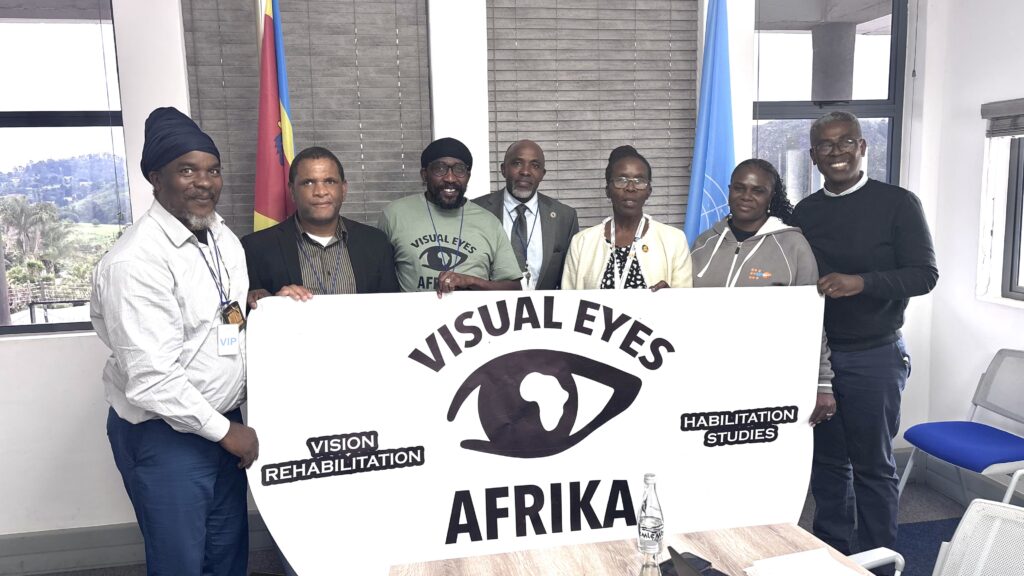
What began as a virtual call soon developed into a focused conversation that highlighted critical gaps in pediatric eye care and clear opportunities for action.
Joining the call were Megan Webber (Co-founder), Helene Dameris, and Ruth Ngaruiya from Know The Glow, alongside Mandla Metula, Director of Eswatini Comprehensive Disability Matters, whom the team was meeting for the first time, and Molemisi Kono from Visual Eyes Africa International, with whom there was already an established rapport.
For Molemisi, the call came at the tail end of an intense three-month stretch of work. He had covered 55,000 miles across Southern Africa, driving through South Africa, Lesotho, Eswatini, Zimbabwe, Zambia, Botswana, and Namibia.
Part of that journey led him to Eswatini, where he spent time with Mandla. What began as a long first conversation over an hour quickly developed into a strong working relationship. By the time they met in person, there was already alignment in how they approached their work. Together, they engaged with government offices, intergovernmental agencies, and local media, and went on to formalize their collaboration through an MOU. During this time, Molemisi also observed firsthand the gaps in pediatric eye care, an issue that would later surface again in this conversation.
Mandla’s contribution to the conversation carried a different trajectory closely tied to the work he leads today. Born with only two percent vision, he progressed through school and tertiary education as his sight steadily declined, eventually losing it completely in 2008. Earlier on, he had been advised to prepare, to build the skills he would need to remain independent and contribute meaningfully once his vision was gone. He acted on that advice.
He learned to use computers through keystrokes and screen-reading software such as JAWS screen reader. He became the first visually impaired person in Eswatini to use a smartphone, and then began teaching others. That knowledge spread, and today many within the visually impaired community use tools he first introduced.
Through ECDMI, his work focuses on ensuring that people with disabilities are not excluded from technology, education, or opportunity. The organisation works across multiple forms of disability, though he noted during the call that visual impairment remains one of the most prevalent in the country. They also support individuals who acquire disabilities later in life, particularly in rebuilding confidence and independence.
Despite broader progress in disability advocacy, early detection of pediatric eye conditions remains inconsistent. Children are still presenting late, often when treatment becomes more complex and outcomes more uncertain. This is where Know The Glow fits in.
Its focus is on helping parents and caregivers recognise early signs such as leukocoria (The Glow) and act on them, linking that moment of recognition to timely care.
As the call came to an end, the discussion shifted to what this could look like in practice within Eswatini. The focus was on using existing structures, community networks, media platforms, and the systems already established by Mandla and Molemisi, to introduce and adapt the approach locally. The emphasis remained practical: reaching parents earlier, making the message relevant, and ensuring it leads to action.