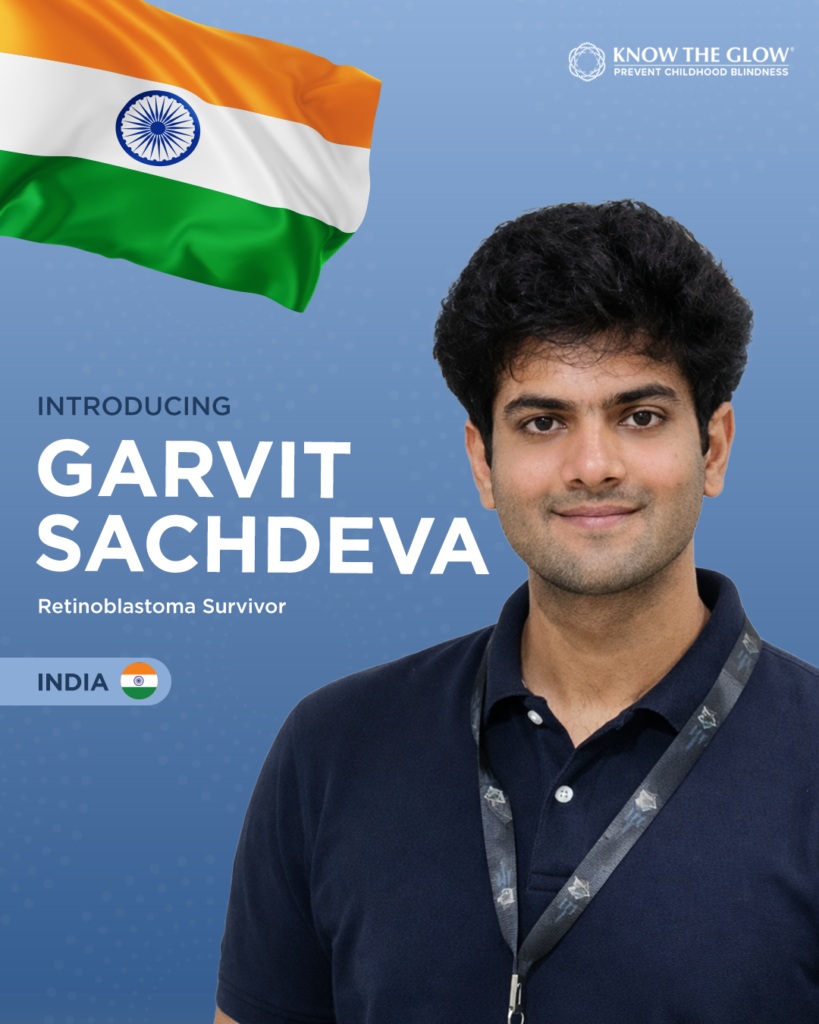
Garvit Sachdeva first connected with KnowTheGlow during a Zoom call with Megan Webber, Co-Founder of KTG and Helene Dameris the director of Global Outreach. What began as a virtual conversation quickly became something more personal, a shared reflection on childhood, family, and the long arc of life after retinoblastoma. From that call emerged a story shaped by instinct, resilience, and purpose.
Garvit Sachdeva was four years old when his father noticed something was wrong, not in a photograph, but in play. One afternoon in Delhi, his father covered Garvit’s eyes with his hands. When his left eye was covered, Garvit immediately pushed the hand away. He could not see. What began as a moment of instinct led to two months of searching for answers and eventually to a diagnosis of retinoblastoma at the All India Institute of Medical Sciences in Delhi.
Garvit came from a conservative middle class family. His father ran a small neighborhood mini mart. His mother was a homemaker. There was no family history of cancer. Nothing that would have prepared them for the word retinoblastoma. Yet once the diagnosis was made, his parents moved with quiet determination. They sought care at AIIMS under Dr. Bakshi and two other physicians who would later oversee his treatment. Despite limited financial resources, they traveled to Hyderabad for a second opinion, with his father staying with relatives because airfare was out of reach. The recommendation was clear and consistent. Enucleation was necessary to save Garvit’s life.
Garvit underwent surgery at the age of four. He did not require chemotherapy or radiation. He has worn a prosthetic eye ever since. He stayed in the hospital for nearly a month, even though his family lived nearby, and was fortunate to be placed in a private room. He remembers walking the hospital corridors after surgery and meeting another young boy who was also preparing for enucleation. The two became brief companions during that long month. He also remembers trying to pull off his postoperative bandages so he could watch his favorite cartoon, while his mother gently but firmly insisted he keep them on.
At the time, prosthetic technology was limited. Garvit was fitted with a stock eye rather than a fully custom one. Years later, he would receive a molded prosthetic that more closely matched his natural eye. When his parents looked back through old family photographs, they were struck by the absence of the glow. There were no clear warning signs preserved in images. His diagnosis had come not through photos, but through a parent’s intuition.
Garvit’s childhood unfolded with structure, discipline, and steady encouragement. He attended a Catholic school where instruction was in English, a deliberate choice by his parents, who were Hindi speaking and had completed only high school. When the school principal initially rejected Garvit, questioning how his parents could support an English education, his father stood his ground. For nearly an hour, the two spoke in different languages, Hindi and English, each making their case. In the end, the principal admitted Garvit.
Like many teenagers, Garvit faced moments of self consciousness, but he was surrounded by a group of friends who created a safe and affirming space. They teased him about his prosthetic eye in a way that was gentle and affectionate, never cruel. That environment allowed him to grow into himself without hiding.
From an early age, Garvit gravitated toward creativity and structure. He painted from the third grade and excelled in mathematics, particularly geometry. Encouraged by a friend of his father, he began building an architecture portfolio while still in high school. He went on to earn a Bachelor of Architecture from Jamia Millia Islamia, interned with Architect Hafeez Contractor in Mumbai, and now works in commercial architecture with JLL in Delhi.
Medically, Garvit remained closely followed. He returned to AIIMS annually until the age of eighteen. His doctors monitored his remaining eye carefully and screened his hearing, aware of the long term risks associated with retinoblastoma survivors. Throughout it all, his parents remained steady. They never allowed his diagnosis to define his limits. They encouraged ambition without hovering, confidence without denial. Garvit describes this balance as essential to who he became.
During those yearly hospital visits, Garvit noticed something that stayed with him. He saw younger children arriving from rural areas, many with bilateral retinoblastoma at very advanced stages. He understood that their outcomes might have been different if families had access to simple information earlier. Awareness, he realized, could change everything.
That realization is what drew him to KnowTheGlow. He was struck by the organization’s commitment to translating materials into languages spoken in rural communities across India and by its focus on educating parents immediately after diagnosis. To Garvit, parents are the first and strongest source of support for a child, and empowering them means empowering the child.
In his first message to KnowTheGlow, Garvit wrote that his journey had shaped both the person he is and his outlook on life. He spoke of resilience learned at home, of strength modeled by his parents, and of a desire to turn personal experience into purpose. Seeing fellow survivor Jared Stodd share openly about identity and confidence encouraged Garvit to do the same and to seek connection with others who understand this path.
Today, Garvit hopes to serve as a touchpoint for KnowTheGlow in India. He is particularly interested in interactive awareness sessions within local communities and in supporting families at AIIMS, where so many retinoblastoma cases in Delhi are first diagnosed. He wants to stand beside parents at the beginning of a frightening journey and help them see what his own parents showed him, that a diagnosis does not define a child’s future.
Garvit’s story is not only about surviving retinoblastoma. It is about instinct, advocacy, education, and the quiet power of parents who refuse to let fear set the limits. It is a reminder that sometimes, the glow is not seen in a photograph, but in what a family chooses to do next.