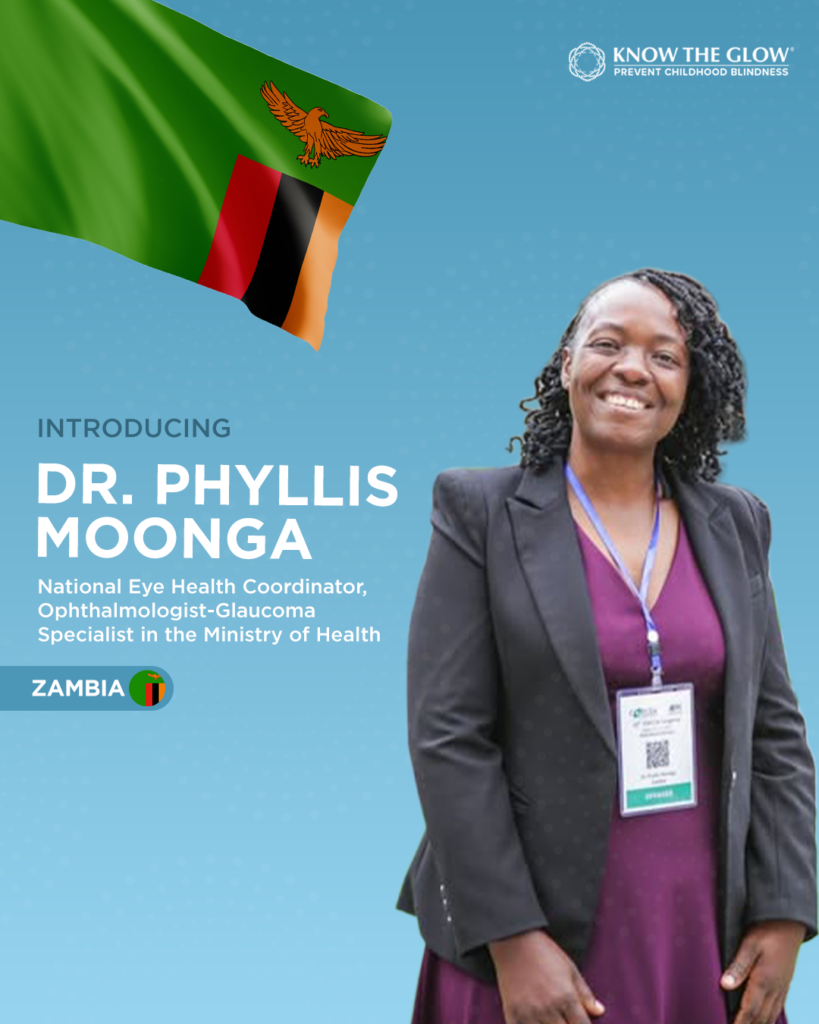
As Know The Glow begins preliminary plans for an awareness campaign in Zambia in 2027, the team, Megan Webber, Co-founder; Helene Dameris, Director of Global Outreach; and Ruth Ngaruiya, Programs Manager for Africa held an evening virtual conversation with Dr. Phyllis Moonga to better understand the state of eye care in Zambia and the role the Ministry of Health is playing in preventing childhood blindness.
As Zambia’s National Eye Health Coordinator and an ophthalmologist by training, Dr. Phyllis’s work is rooted not only in clinical care, but in ensuring that children and adults are seen early enough for that care to make a difference.
Her journey into ophthalmology was not the path she first imagined. After completing her medical degree in St. Petersburg,Russia, she returned to Zambia intending to pursue general surgery. But after just three months in surgical residency, she realized her interests and long-term vision pointed her in a different direction. She wanted a specialty that still involved surgery but offered a better fit for the life she hoped to build, and ophthalmology became that path.She later specialized in Zambia and went on to complete a glaucoma fellowship in Bangladesh, experiences that broadened both her clinical expertise and global perspective.
Today, alongside her work as a glaucoma specialist, a significant part of her focus is on one of the country’s eye health services among which, the most urgent is pediatric eye health challenge: retinoblastoma. The concern, she explains, is not merely the disease itself, but when children arrive for care. Very few cases present at the stage where a white glow in the eye is the only visible sign. More often, children arrive with advanced extraocular disease, when the cancer has already spread beyond the eye and treatment options become far more limited. Survival rates remain distressingly low, with the five-year survival rate hovering below twenty percent.
When families do present early, the tumor may still be small enough to treat with laser therapy or cryotherapy. Yet even after receiving counseling, some families hesitate to accept interventions such as enucleation. Others first seek help from churches or traditional healers, returning only when the disease has progressed significantly. In some cases, fathers abandon the family, placing blame on the mother and leaving mothers and grandmothers to carry the burden of the child’s care alone.
For Dr. Phyllis, the answer begins at the community level. Through the Ministry of Health, she and her colleagues have led training efforts for community health workers and primary healthcare providers across Zambia. Through repeated training sessions, frontline workers are being taught to identify what the glow means, understand the progression from intraocular to extraocular disease, and recognize the urgency of referral.
These efforts are increasingly being integrated into existing child health services. During vaccination visits and child health weeks, primary healthcare workers are now being encouraged to examine children’s eyes and refer suspicious cases early. However, scaling this consistently across the country remains difficult due to funding limitations and the vast geographic distances involved.
Zambia has only a few centers equipped to provide ophthalmic surgery, and only one dedicated CancerDiseases Hospital in the capital, Lusaka where chemotherapy can be administered. This means that children diagnosed in remote regions often travel hundreds or even thousands of kilometers for treatment. Yet despite these obstacles, systems are being built to keep families engaged. When children are due for follow-up, teams call caregivers directly, and where transport costs are a barrier, social welfare services are engaged to help families return for review.
Her work also extends deeply into training the next generation of clinicians. Ophthalmology is a mandatory rotation for all medical students, and the country’s teaching hospitals for ophthalmology host residents from across Africa and beyond, including Ethiopia, Botswana, Lesotho, the Democratic Republic of Congo. . Every undergraduate medical student who passes through the system must understand leukocoria and be able to identify its many differential diagnoses, because early detection often depends on the very first clinician who sees the child.
Beyond hospitals and training institutions, she sees communication and awareness as equally essential. School eye health programmes have also been scaled across the country, especially in lower grades, ensuring that children are screened early for refractive and other vision issues. At the same time, Zambia’s eye health ecosystem benefits from a strong network of organizations including Orbis, CBM, Essilor-Luxottica Foundation, Sightsavers and others that work collaboratively rather than in silos. These organizations meet quarterly to align efforts, reduce duplication, and ensure that different parts of the eye care system are strengthened together.
One of the most promising opportunities lies in technology-enabled screening. Dr. Phyllis highlighted the value of tools such as the Arclight, particularly for primary healthcare workers in remote settings. When equipped with smartphone-compatible tools, healthcare workers can capture and forward images for specialist review, making it easier to identify urgent cases before families undertake long journeys.
Yet for all the systems, trainings, and partnerships, her vision remains remarkably simple. In a perfect world, she says, everyone would have access to treatment when they need it.
We are deeply appreciative of the work being led by the Ministry of Health through Dr. Phyllis Moonga and the many other partners strengthening eye health in Zambia.
As Know The Glow plans for its awareness campaign in Zambia, we look forward to continued engagement with doctors, health workers, and organizations across the country to better understand where we can contribute meaningfully, supporting the existing systems and becoming an additive part of the care continuum already in place.