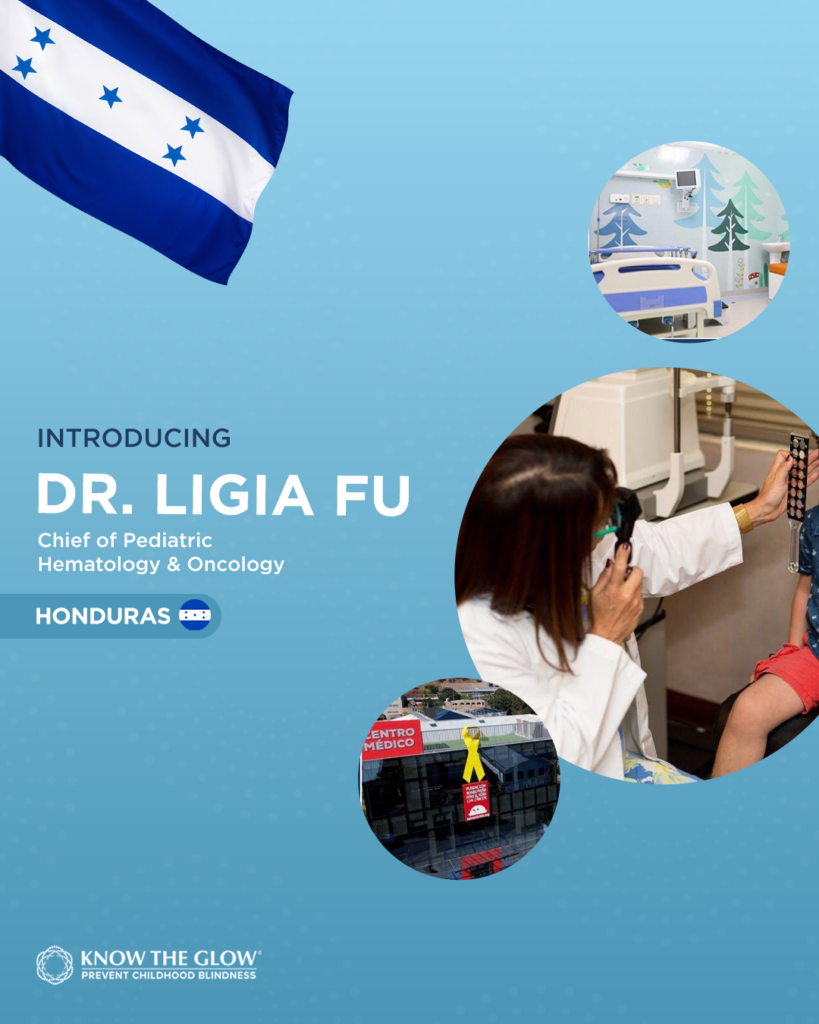
Megan Webber connected with Dr. Ligia Fu at the ISOO Conference in Rio de Janeiro, where they discussed the progress that she and her colleagues have helped build for children with retinoblastoma in Honduras, a country where access to specialized pediatric cancer care has historically been limited. As a pediatric oncologist deeply committed to both treatment and early detection, Dr. Fu has spent decades working alongside local foundations for childhood with cancer , healthcare institutions, government agencies, and fellow clinicians to address not only the disease itself, but the systemic barriers that can delay diagnosis and care.
Early in this work, Dr. Fu and her colleagues recognized that children with retinoblastoma were arriving too late for the most effective treatment, often because families and frontline providers were unfamiliar with early warning signs such as leukocoria. This led to an initial effort to bring retinoblastoma awareness directly into communities through an existing and trusted public health system: childhood vaccination campaigns.
Working with the Honduran Foundation for Children with Cancer and the Secretary of Health, educational flyers were distributed to families during government vaccination campaigns for young children. An initial small grant helped fund the first materials, but as the initiative continued, the Honduran Foundation for Children with Cancer provided ongoing financial support for the printing and distribution of the materials. The Foundation’s relationship with government health authorities was also instrumental in helping connect the awareness initiative with the country’s public health infrastructure, allowing the effort to become more sustained and far-reaching.
Over time, this early retinoblastoma initiative grew into a broader childhood cancer awareness effort. Educational materials were expanded to include additional signs and symptoms of childhood cancers, while retinoblastoma and leukocoria remained part of the message shared with families and communities.
International Childhood Cancer Day, recognized annually on February 15, has become another important opportunity for education and outreach. Together with the local foundation and other partners, Dr. Fu and her colleagues have participated in large-scale awareness activities through educational materials, newspaper coverage, television interviews, and other media outreach. These efforts have helped bring conversations about childhood cancer, including the warning signs of retinoblastoma, to a much broader national audience.
Awareness, however, is only effective when children who are identified can be connected to appropriate evaluation and treatment. Strengthening that pathway has required another important layer of collaboration.
Because specialized ophthalmology services are not available within Dr. Fu’s public hospital setting, children with suspected or diagnosed retinoblastoma are referred to Fundación Santa Lucía, a foundation established through a private ophthalmology center in Honduras. There, children can receive specialized ophthalmic evaluation under anesthesia as well as treatments including laser therapy and enucleation when needed paid by Honduran Foundation for Children with cancer. Their cancer care is coordinated through the public hospital, with support from the Honduran Foundation for Children with Cancer, the families of children with Retinoblastoma don’t pay their children´s treatment because they are supported by Honduran Foundation for Children with cancer.
This has created an important three-way collaboration among the public hospital, the Honduran Foundation for Children with Cancer, and Fundación Santa Lucía, with each partner contributing a different piece of the care pathway. Together, they help bridge gaps between diagnosis, ophthalmic evaluation, cancer treatment, and family support.
That collaborative approach has been particularly important in addressing another longstanding challenge: treatment abandonment. When Dr. Fu began this work in the early 2000s, financial pressures, limited understanding of the disease, and the practical challenges of accessing care could make it difficult for families to complete treatment. Over time, stronger family support systems and the involvement of local foundations have helped change that reality. Parent networks, including WhatsApp groups, now provide families with connection and encouragement, while survivors and parents can help other families understand what lies ahead and remain engaged throughout treatment.
Local foundations have also become important advocates for children with cancer, building relationships with government agencies, organizing national awareness efforts, and supporting policies that strengthen childhood cancer care. Recent legislative progress recognizing the government’s responsibility for childhood cancer care reflects years of sustained advocacy by clinicians, foundations, families, and other stakeholders.
The spirit of collaboration extends beyond Honduras. Dr. Fu and her colleagues work with pediatric oncology professionals throughout Central America through AHOPCA, a regional consortium focused on improving care for children with cancer. Through this network, professionals in countries including Honduras, Guatemala, Nicaragua, Panama, Costa Rica, Haiti, Dominican Republic and El Salvador are able to share knowledge, experience, and approaches to the challenges they face across the region. Pediatric Oncologists´engagement with universities also contributes to the training of future healthcare professionals and increase of early detection of childhood cancer among the primary care health professionals and continued research in pediatric oncology.
Despite meaningful progress, challenges remain. Access to some advanced retinoblastoma treatments is still limited, and continued investment in early recognition, referral pathways, professional education, and family awareness remains essential.
But the story of retinoblastoma care in Honduras also demonstrates what can happen when awareness and treatment are not approached in isolation. What began with an effort to educate families about leukocoria through vaccination campaigns has grown through years of cooperation among clinicians, foundations, government agencies, ophthalmologists, parents, survivors, and regional partners.
Dr. Fu continues to advocate for expanding awareness and finding new ways to help families and healthcare providers recognize children at risk earlier. Her work, and that of the many partners who have helped build this network, offers an important example of locally led collaboration: creating stronger systems so that children with retinoblastoma are not only able to receive treatment, but are identified and connected to that treatment in time.