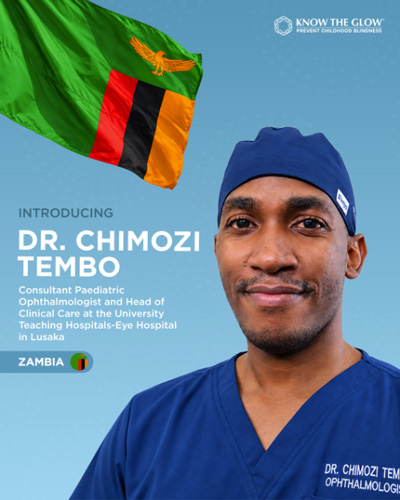
KnowTheGlow recently had the opportunity to speak with Dr. Chimozi Tembo, Consultant Paediatric Ophthalmologist and Head of Clinical Care at the University Teaching Hospitals-Eye Hospital in Lusaka, Zambia’s national referral eye hospital. Joined by KnowTheGlow Co-founder Megan Webber, Director of Global Outreach Helene Dameris, and Program Manager Ruth Ngaruiya, the conversation provided valuable insight into Dr. Tembo’s journey into medicine and the challenges of delivering paediatric eye care in Zambia.
As Head of Clinical Care at the University Teaching Hospital, Dr. Tembo’s work extends beyond caring for children with complex eye conditions. While his clinical expertise includes paediatric ophthalmology, strabismus, and neuro-ophthalmology, his leadership responsibilities now extend to strengthening clinical services, developing sustainable eye care programmes, and expanding access to quality eye care across Zambia. Although his administrative responsibilities have reduced his time in the clinic, he remains deeply committed to patient care and to training the next generation of ophthalmologists, having previously served as Head of Training and Research, where he played a key role in coordinating residency training and academic programmes. For Dr. Tembo, building the next generation of ophthalmologists is just as important as treating today’s patients, helping ensure that more children across Zambia will have access to specialised eye care in the years to come.
Dr. Tembo’s journey into medicine began with encouragement from his late mother, a nutritionist, whose belief in his potential inspired him to pursue a career in medicine. Although he had initially entertained the idea of becoming an engineer, he followed her advice and entered medicine, a decision that ultimately shaped his life’s work. He remains deeply grateful for her guidance and the lasting influence she had on his career. His passion for ophthalmology developed during a rural posting in Zambia’s Eastern Province early in his career, where he witnessed firsthand the immense demand placed on the province’s only ophthalmologist. He recalled seeing elderly patients arrive at the eye clinic accompanied by young grandchildren who had missed school to guide and care for them, recognising that avoidable blindness was not only a health issue but also one that affected education, livelihoods, and entire families. It was a powerful reminder that restoring sight can change far more than a patient’s vision; it can change the future of an entire family. That experience inspired him to dedicate his career to expanding access to quality eye care for those who need it most.
His career has also been shaped by international partnerships and professional development opportunities. Orbis International supported his specialised training in paediatric ophthalmology in India. In 2025, he received the prestigious Marilyn Miller Travel Grant, and participated in the AAPOS meeting in Salt Lake City where he also had the opportunity to observe clinical practice at the Moran Eye Center. He was also selected for the American Academy of Ophthalmology (AAO) Rotary Club Host Project in Jacksonville, Florida, where he participated in a school vision screening programme with Vision is Priceless and subsequently attended the AAO Annual Meeting in Orlando. This year, he completed advanced international training in paediatric eye disease at Peking University People’s Hospital in Beijing, China. Dr. Tembo expressed gratitude for these opportunities, noting that they have equipped him with the knowledge and skills to strengthen paediatric ophthalmology services, improve patient care, and help train future ophthalmologists in Zambia.
Drawing upon years of clinical practice and national leadership, Dr. Tembo reflected on the broader challenges facing childhood eye care in Zambia. Despite significant progress in recent years, the country has fewer than five paediatric ophthalmologists serving a population of approximately 20 million people. Children with congenital cataracts often present at eight or nine years of age, long after the ideal window for treatment has passed. Poverty, geographical barriers, limited awareness, and shortages of trained personnel all contribute to these delays. He also highlighted the absence of a national screening programme for conditions such as retinopathy of prematurity, leaving another vulnerable group of children at risk of delayed diagnosis.
One of the most important messages Dr. Tembo shared is that leukocoria, or the “glow,” is a clinical sign, not a diagnosis. He stressed that healthcare workers must recognise that leukocoria can be a sign of several serious childhood eye conditions, each requiring a different diagnostic and management approach. He described a recent case in which two children who had initially been diagnosed with retinoblastoma travelled to India for a second opinion before definitive treatment was undertaken, only to discover that they had Coats disease, a non-malignant condition requiring a very different course of care. At the same time, he noted that children who do have retinoblastoma are sometimes diagnosed too late, reducing their chances of successful treatment. These experiences reinforce the importance of increasing awareness of leukocoria, ensuring timely referral, and establishing an accurate diagnosis before treatment decisions are made.
Despite these challenges, Zambia is making meaningful progress toward earlier detection. Zambia has incorporated the red reflex test into its national Under-Five Health Card, and training programmes are helping frontline healthcare workers recognise common childhood eye conditions and understand when referral is needed. While these are important advances, Dr. Tembo noted that workforce shortages and limited access to basic screening equipment continue to make implementation challenging in many settings. He believes that increasing awareness among communities and healthcare providers remains one of the most effective ways to ensure children are identified and referred before vision or life is permanently affected.
KnowTheGlow is grateful to Dr. Tembo for sharing his experiences, insights, and vision for strengthening paediatric eye care in Zambia. As preparations continue for our Zambia awareness campaign, timed to coincide with the 2027 COECSA Congress, we look forward to supporting efforts to raise awareness of leukocoria, encourage earlier recognition of childhood eye conditions, strengthen referral pathways, and help ensure that more children receive timely, sight-saving care.