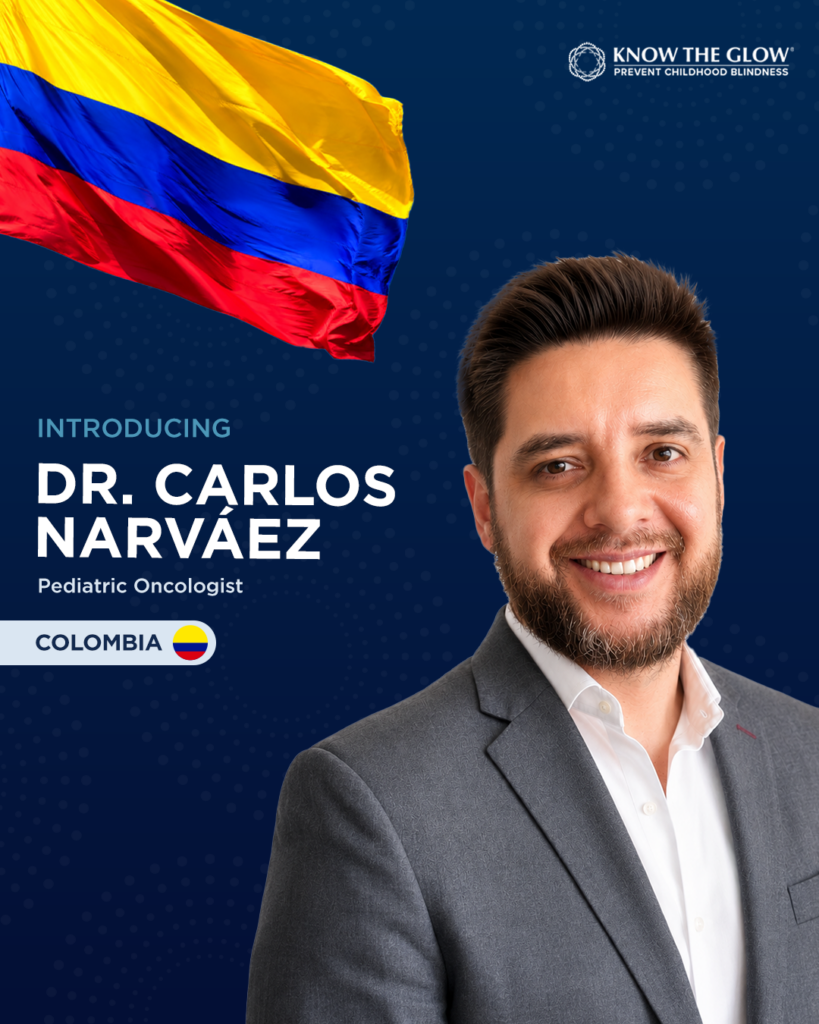
Recently, the team at KnowTheGlow met with Dr. Carlos Narváez, a pediatric hematologist-oncologist from Cali, Colombia, with a special interest in the study, treatment, and early detection of retinoblastoma. Over the past several years, his work has focused on improving outcomes for children with retinoblastoma through earlier diagnosis, increased awareness, multidisciplinary collaboration, and expanded access to specialized care.
Over the past several years, his work in retinoblastoma has led him to collaborate with international initiatives focused on early diagnosis, including serving as one of the representatives for Central and South America within the St. Jude Global Retinoblastoma Program Early Diagnosis Working Group.
Megan Webber, Co-Founder of KnowTheGlow, first met Dr. Narváez earlier this year at the International Society of Ocular Oncology meeting in Brazil, where he approached her about the possibility of helping support a future awareness campaign in Colombia. The recent conversation brought together shared expertise, data-driven insights, and a common goal of ensuring that more children are diagnosed before the disease progresses to advanced stages.
Dr. Narváez provided an overview of the current state of retinoblastoma care in Colombia and emphasized that one of the country’s greatest challenges is the timing of diagnosis. While survival rates in many high-income countries now approach 100%, overall survival in Colombia exceeds 80%, but remains lower than that reported in many high-income settings. Dr. Narváez explained that this gap is largely due to children arriving for specialized care too late in the course of their disease.
One statistic in particular stood out during the discussion. Dr. Narváez shared that 46% of children diagnosed with retinoblastoma in Colombia present with Group E disease, the most advanced stage of intraocular retinoblastoma. At this stage, treatment often requires enucleation, systemic chemotherapy, or other intensive interventions to save the child’s life. He emphasized that earlier recognition of warning signs could dramatically improve both survival outcomes and the possibility of preserving vision.
Despite these challenges, Colombia has developed a strong foundation for pediatric oncology care. The country maintains an established retinoblastoma registry system that allows clinicians to track patient outcomes and survival trends.
Colombia has a healthcare system with broad insurance coverage through both contributory and subsidized health plans, allowing most children diagnosed with retinoblastoma to access treatment. However, access to care remains influenced by multiple factors, including socioeconomic conditions, geographic barriers, administrative processes within the healthcare system, referral pathways, and the availability of specialized services.
While an increasing number of centers, particularly in major capital cities throughout the country, are capable of providing systemic chemotherapy and multidisciplinary care, families often face challenges navigating the healthcare system. Delays in referrals, authorization processes, transportation difficulties, and the need to travel long distances for specialized care can all contribute to delays in diagnosis and treatment. In some cases, these barriers may also increase the risk of treatment interruption or abandonment.
The challenge is not a single barrier, but rather the cumulative effect of multiple barriers that can delay a child’s journey from the first symptom to specialized treatment.
Dr. Narváez also highlighted the limited availability of highly specialized services throughout the country. While an increasing number of centers can provide systemic chemotherapy for retinoblastoma, advanced interventions such as intra-arterial chemotherapy, intravitreal chemotherapy, and RETCAM imaging remain available in only a few specialized institutions.
One of the challenges is that many children in Colombia continue to be diagnosed with advanced disease. As a result, relatively few patients are candidates for focal therapies typically used in earlier-stage disease (Groups A, B, and C). This reality creates a difficult environment for investment in highly specialized technologies, as hospitals and healthcare payers may be reluctant to acquire expensive equipment that is expected to benefit a relatively small number of patients under current diagnostic patterns.
In addition, Colombia has a limited number of pediatric ophthalmologists and ocular oncology specialists, creating an ongoing need for greater awareness, training, and capacity building among healthcare professionals.
A major focus of the conversation centered on opportunities for earlier detection through routine vision screening. Dr. Narváez explained that while Colombia’s healthcare system has many strengths, red reflex testing is not consistently incorporated into routine pediatric evaluations. He emphasized the importance of red reflex screening as a simple, rapid, and highly effective tool that should be performed beginning in infancy and throughout early childhood. The examination takes only seconds to perform but can dramatically improve the likelihood of detecting retinoblastoma and other serious eye conditions at an earlier stage.
After learning more about KnowTheGlow’s work and seeing examples of the ArcLight scope, Dr. Narváez expressed enthusiasm about the potential to introduce this technology in Colombia. Having previously observed its effectiveness during meetings in Rio de Janeiro, he recognized its value as a practical and accessible tool for expanding screening capacity and training healthcare professionals, particularly in resource-limited settings.
Megan and Dr. Narváez explored how these existing resources could be adapted for Colombia. Dr. Narváez expressed interest in sharing KnowTheGlow materials with organizations such as ACHOP (the Colombian Association of Pediatric Hematology and Oncology) and SLAOP (the Latin American Society of Pediatric Oncology) to encourage broader engagement around early detection initiatives. Opportunities for co-branded educational materials with local hospitals, professional societies, universities, patient advocacy organizations, and potentially public health stakeholders were also discussed.
The conversation extended beyond awareness campaigns to include future advocacy and educational efforts. As a moderator for an upcoming early diagnosis session at the SIOP Congress in San Antonio, Dr. Narváez identified opportunities to incorporate KnowTheGlow materials into presentations and discussions with international colleagues. The group also discussed future conferences, webinars, and hospital-based awareness activities where educational resources could be shared.
Recognizing the importance of community-centered solutions, Dr. Narváez also raised the possibility of implementing tools such as WhatsApp-based communication systems to support families throughout treatment and help reduce abandonment rates. The ability to share survivor stories from Colombia would be a powerful way to highlight both the challenges families face and the hope that early diagnosis can provide.
The conversation reinforced a shared commitment to strengthening early detection efforts and advancing retinoblastoma awareness throughout Colombia. It reflected a growing sense of collaboration built on mutual respect, shared expertise, and a common belief that earlier diagnosis can dramatically change outcomes for children and families.
Together, KnowTheGlow and Dr. Narváez expressed hope for continued partnership in the years ahead, united by the vision that every child in Colombia deserves the opportunity to be diagnosed earlier, treated sooner, and given the best possible chance not only to survive retinoblastoma, but to preserve vision and thrive beyond it.