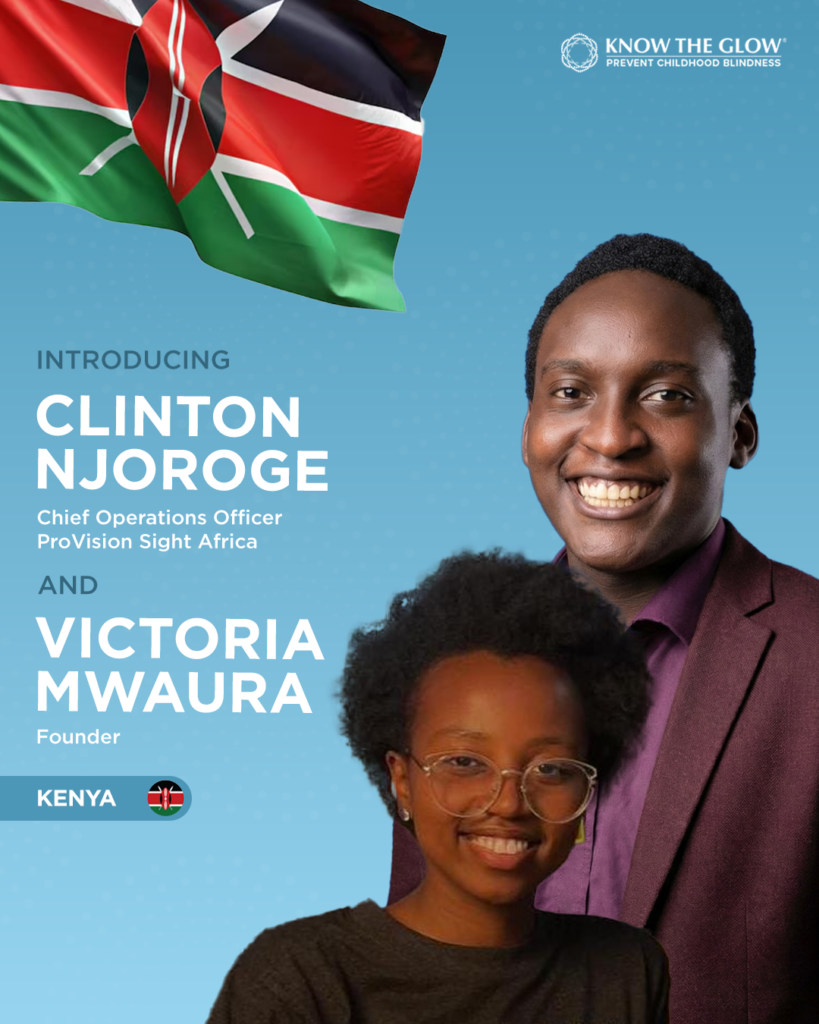
KnowtheGlow’s Megan Webber, Co-Founder, Helene Dameris, Director of Global Outreach, and Ruth Ngaruiya, Programs Manager for Africa, recently had a virtual call with Victoria Mwaura, founder of ProVision Sight Africa, and Clinton Njoroge, the organization’s Chief Operations Officer, to learn about the smart glasses they’ve built for people living with irreversible vision loss.
For Victoria, starting ProVision Sight Africa was deeply personal, far more than launching a tech start-up. Growing up, she watched glaucoma, which runs through one side of her family, take the sight of both her grandmother and grandfather and several other relatives, most of them farmers in rural Murang’a County. As their vision deteriorated, she saw not only the practical challenges they faced but also the emotional and social toll that followed. Living in rural Kenya, they became increasingly dependent on family members for everyday activities. Everyday activities that most people take for granted suddenly became difficult or impossible. One memory in particular stayed with her: an aunt who could no longer tend her own farm, who felt she’d become a burden to the children now caring for her, and who lived on hilly terrain where every trip outside the house carried real risk.Victoria began researching what might help and came across the white cane as one of the few mobility aids available. However, her relatives’ children hesitated, unsure how it would be received in a community where sudden blindness is sometimes mistaken for something else entirely, even witchcraft.
Victoria wanted to build something that gave her aunt back a measure of independence, and dignity along with it. Watching those experiences unfold sparked a question that would eventually shape her future: how could technology help restore independence and dignity for people who have permanently lost their sight?
That question became ProVision Sight Africa. The smart glasses Victoria and Clinton have built are designed specifically for the environments most assistive technology overlooks. They describe a room, identify objects, recognize people and even describe how someone looks or what they’re wearing. They can also read printed text aloud and guide a user toward a chosen destination. A dedicated button lets someone call for help twice in an emergency. The glasses work fully offline as well as online, an essential feature in places where connectivity is unavailable, and they’re built to recognize distinctly local touchstones.
Getting there wasn’t easy. Early prototypes were bulky, closer to ski goggles than glasses, and ran on a Raspberry Pi as the team worked through both the engineering and the design. Testing with visually impaired students, many of whom they reached through partners like Kilimanjaro Blind Trust and Kenya Society for the Blind, shared their feedback that reshaped almost every part of the device, and it’s that feedback that eventually pushed the team from an app toward the glasses themselves.
Ten devices are currently in use through Kenya Society for the Blind and Kilimanjaro Blind Trust, including three worn by visually impaired teachers and rather than selling directly to individuals, ProVision works through organizations already trusted by the community, which keeps costs down and pairs every device with the training and support new users need, typically no more than an hour before someone feels at ease with it. They are currently nearing completion on a smaller, child-friendly version, along with a compact companion device built for students who aren’t permitted to carry phones in Kenyan schools. They are expanding language options, with Swahili, Kikuyu, and Luo now in progress alongside English.
ProVision Sight Africa was featured in the Innovative Showcase at the 2030 In Sight Live and was featured in Health Business in June of this year regarding her glasses as exemplifying the potential of AI Wearable Technology to support those living with blindness.
KnowtheGlow’s work has always centered on early detection, helping families recognize the glow in a child’s eye that can signal a serious, sometimes fatal, eye condition. ProVision Sight Africa picks up a related thread: supporting people for whom sight has already been lost, and helping them reclaim their independence. It’s a natural point of connection between two organizations working on different sides of the same problem. KnowtheGlow looks forward to sharing more of Victoria and Clinton’s work in the months ahead, and to watching where ProVision Sight Africa goes from here.