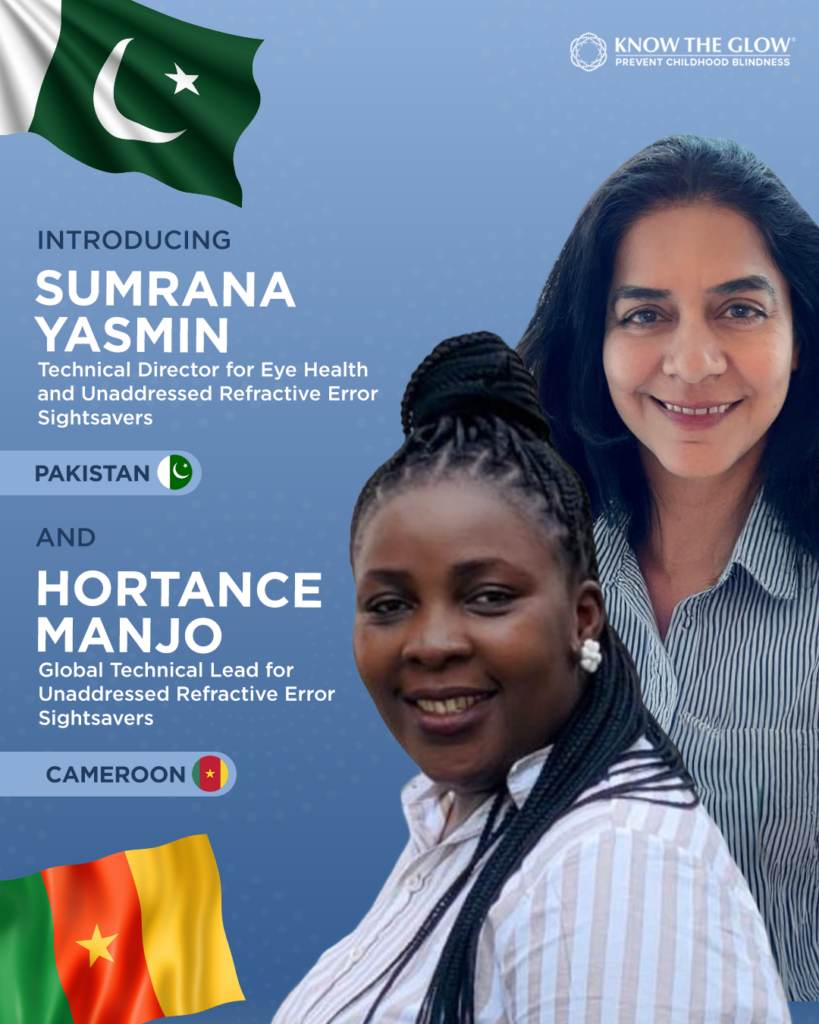
Sightsavers has long been a leader in advancing eye health across Asia and Africa, working to ensure that children and adults alike have access to quality vision and eye care. This was reflected in a recent discussion with Sightsavers leaders Sumrana Yasmin, Technical Director for Eye Health and Unaddressed Refractive Error, and Hortance Manjo, Global Technical Lead for Unaddressed Refractive Error (URE), alongside Megan Webber, Co-Founder of Know The Glow (KTG), and Ruth Ngaruiya, Program Manager for Africa.
As Sightsavers marks its 75th anniversary, the organization is further strengthening its focus on integration and sustainability and scale, recognizing that vision cannot be addressed in isolation. This approach involves close collaboration with Ministries of Health, Education, Finance and Women Development local partners, and the private sector. Sumrana explained that Sightsavers’ programs are designed with an aim of long term investment, allowing enough time to strengthen local health and education systems rather than deliver short-term fixes.
This long-term commitment sustains the organization’s presence in 33 countries across sub-Saharan Africa and South Asia including; Kenya, Uganda, Tanzania, Malawi, Zambia, Zimbabwe, Nigeria, Sierra Leone, Liberia , Senegal, Cameroon, India, Pakistan, Bangladesh, and Mali, among others where generating demand for services must go hand in hand with ensuring the health systems are prepared to respond.
A cornerstone of this systems-based approach is the School Health Integrated Program (SHIP). Drawing on her hands-on experience supporting refractive error programs across Africa, Hortance described SHIP as a vital bridge between classrooms and clinics. Teachers are trained to conduct basic vision tests, effectively creating thousands of screening points, while community health workers, parent groups, organisations of persons with disabilities, and even traditional healers are engaged to identify children with vision problems, guide families through referral pathways, and support follow-up care.
This approach extends well beyond the school environment. Hortance highlighted how community health workers conduct outreach to identify children who may be out of school or too young for formal education. Reaching children remains particularly critical, as this is the most important window for intervention for refractive error and more serious eye conditions. To better reach younger children (0-5), Sumrana and her team are increasingly focusing on Maternal and Child Health (MCH) clinics, recognizing that the best time to reach a parent is during routine vaccinations or infant checkups.
Another important addition in Sightsavers’ programming is its expanding focus beyond vision alone. As Sumrana noted, the organization is now integrating hearing screening into its eye health programmes, working alongside specialized local partners to address sensory impairment more holistically, ensuring children receive the support and care they need, including strengthening referrals to surgical or medical interventions when required.
Sumrana and Hortance also highlighted Sightsavers’ strong commitment to disability inclusion, ensuring that children and adults with visual impairments can access education, assistive products, and opportunities to participate fully in their communities.
Looking ahead to 2026, Sightsavers remains focused on strengthening seamless transitions, from community awareness and early detection to diagnosis and timely treatment, so that no child or adult falls through the gaps or loses their sight unnecessarily. The conversation highlighted how important it is for aligned organizations to work closely together, sharing a commitment to early detection, family support, and practical, coordinated approaches that help prevent avoidable vision loss.
Know The Glow looks forward to meeting Sumrana and Hortance in person at the IAPB conference in Kenya in June of 2026. We are proud to highlight Sightsavers and celebrate their 75 years of global impact.