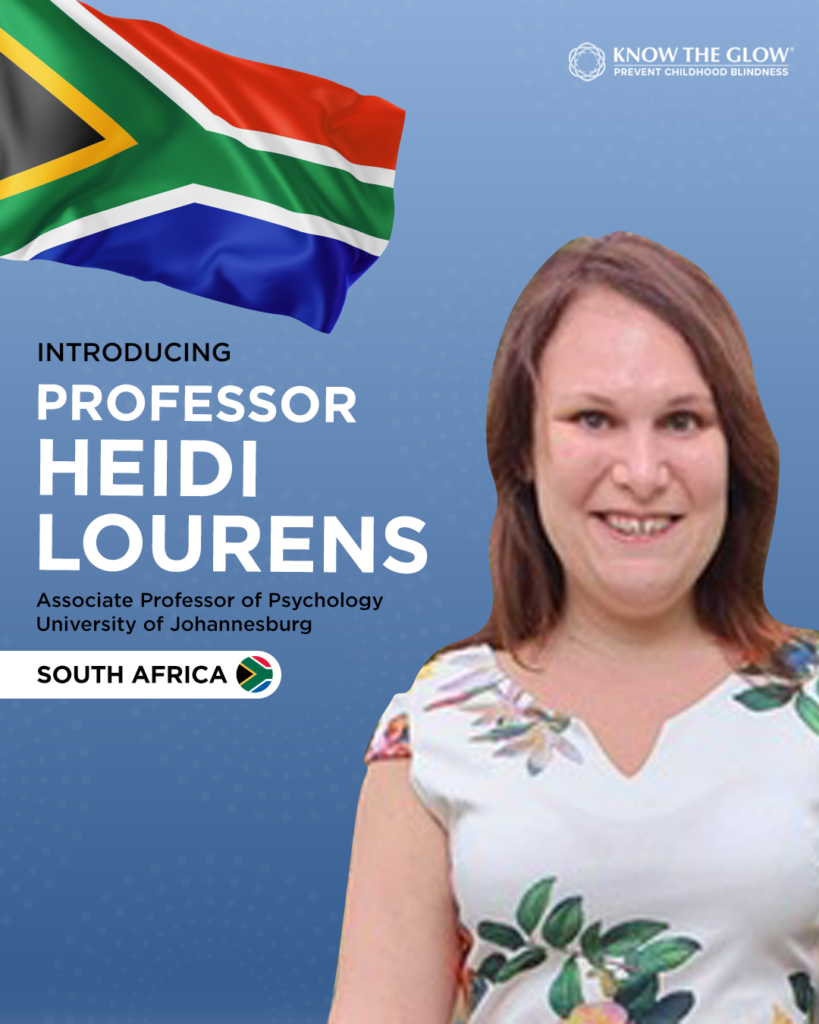
When KnowTheGlow’s Program Manager for Africa, Ruth Ngaruiya, first came across the work and research of Professor Heidi Lourens, she was struck by both the depth of Heidi’s scholarship and the remarkable story behind it. Ruth was fascinated by the research Heidi had conducted and quickly realized that her personal journey as a retinoblastoma survivor made her perspective even more powerful. Ruth connected Heidi with the KnowTheGlow Co-Founder, Megan Webber and Director of Global Outreach, Helene Dameris, for a conversation that revealed a life shaped by resilience, independence, and determination.
Today Professor Heidi Lourens is an associate professor of psychology at the University of Johannesburg in South Africa. Her academic work focuses on disability and the experiences of students with visual impairments in higher education. As a survivor of retinoblastoma, though, her life was shaped long before she entered academia.
Heidi was diagnosed with retinoblastoma as a baby. At the time, awareness of The Glow, the white reflection that can appear in a child’s eye and signal retinoblastoma, was far less common, and Heidi’s family had never heard of it. When Heidi was about three to four months old, her father began to sense that something was not quite right with her eye. It seemed to turn inward at times, and he wondered if it might simply be a squint. When her parents brought the concern to a doctor, they were reassured that the eye muscles of infants are still developing and that the issue would likely correct itself with time.
But Heidi’s parents trusted their instincts. They continued searching for answers until the correct diagnosis of retinoblastoma was finally made. Heidi was only six months old when surgeons removed her right eye at Groote Schuur Hospital in Cape Town. The hospital is historically significant as the site where the first successful human heart transplant was performed. Heidi was treated by an exceptional medical team that included oncologist Dr. Clare Stannard.
When Heidi received her first prosthetic eye later that year, it brought enormous comfort to her mother. At first, Heidi’s mother had been devastated by the diagnosis and worried what her daughter’s future might be like. But she soon gathered herself and decided that Heidi would be raised exactly like her other children.
From the beginning, Heidi’s parents were determined that she would grow up independent. There was no room for self pity in their home. Heidi did chores, washed dishes, and learned the everyday routines of family life just like everyone else. Her father often told her with certainty that she would go to university one day.
Her mother reinforced that same philosophy of independence in quieter but equally powerful ways. She once told Heidi about two blind colleagues she had worked with at an insurance company. When someone offered them coffee, one man would say yes, but the other would reply, “No, I will get it myself.” It was a small moment, but it stayed with her mother. She wanted Heidi to grow up with that same sense of self reliance.
At the age of five Heidi began attending a school for the blind where she learned Braille. At the time she still had about ten to fifteen percent vision in her remaining eye. Because of that early vision, she built a strong visual memory that she still carries today. She can remember her parents’ faces, what trees look like, and the colors of the world she once saw.
When Heidi was nine years old she experienced a moment that would leave an indelible mark in her life forever. She was in a supermarket with her mother walking across a floor that had blue and white stripes. Suddenly the blue stripes began to look pink. At first she thought the floor might be dusty. Soon everything became blurry. Moments later her vision disappeared completely.
Heidi remembers the moment vividly. The darkness came quickly, almost like a bat sweeping across her eyes. One moment she could still see shapes and colors, and the next everything was gone. Doctors initially believed it might be a bruise in the eye that would clear within a few months, but the weeks passed and her vision never returned. Heidi still remembers sitting on the floor crying with her mother before they went to the doctor, both of them trying to understand what was happening. She was in the fourth grade at the time and already attending a school for the blind. Until then she had been adventurous and energetic, always eager to explore the world around her but she later regained her sense of adventure and now does things like skydiving, bungee jumping and even cooking different recipes. Losing the last of her sight was a profound shock, and for a time it shook the confidence that had come so naturally to her as a child.
Despite the challenges, her parents never changed their expectations for her future. After finishing high school Heidi enrolled at Stellenbosch University to study psychology. For the first time she was attending a university designed for sighted students rather than a specialized school for the blind. Once she learned the campus routes and relied on her Braille skills, she quickly found her footing.
She completed her master’s degree in counseling psychology in 2009 and later returned to earn her doctorate in 2015. For several years she worked as a practicing psychologist while completing her PhD, but she eventually realized that her true passion was research and teaching.
Today Heidi serves as an associate professor of psychology at the University of Johannesburg, where she was promoted in 2020. She teaches courses in psychopathology, child psychology, and trauma. Her research focuses on disability and the experiences of visually impaired students in higher education. Many of her graduate students now conduct research on disability as well.
Heidi describes the university as an accepting and supportive environment where she is treated simply as another colleague. She jokes that her colleagues remind her of her mother because they expect her to succeed and hold her to high standards.
In 2019 Heidi underwent sinus surgery to remove a cyst. Around that time her remaining eye began to cause significant pain. Because of her history with retinoblastoma she feared the worst. She consulted Dr. Hamza Mustak, who Megan Webber noted is also part of the international RBNet network alongside Dr. Didi Fabian. He explained that the discomfort might be related to calcified tumor tissue.
After discussing the situation Heidi decided to have the eye removed since it no longer provided any light perception. Dr. Hamza placed orbital ball implants to help prosthetic eyes move more naturally. Although the surgery itself was straightforward, Heidi describes the emotional adjustment afterward as unexpectedly difficult. For a time she became self conscious at work because colleagues now knew she had prosthetic eyes. Over time that feeling faded. Today she says she truly does not worry about what people think and speaks passionately about the importance of prosthetic eyes for confidence and self esteem. In South Africa prosthetics are often classified as cosmetic and are not covered by insurance, which makes them extremely expensive. Heidi believes this is an issue that deserves far greater attention because prosthetics play an important role in a person’s dignity and self confidence.
For many years Heidi relied on a long cane to navigate the world. In South Africa individuals can only apply for a guide dog after the age of eighteen. Heidi did not receive her first guide dog until she was twenty eight because she initially wondered whether the responsibility might be overwhelming.
Her first dog, Gulliver, was a Weimaraner and Labrador mix trained by the South African Guide Dogs Association in Cape Town. The impact was life changing. Before Gulliver Heidi often felt trapped at home because she could not easily travel independently. With her guide dog she suddenly gained the freedom to walk wherever she wanted. Today her guide dog is Upton, a lively seven year old black Labrador who still behaves like a puppy. Heidi also shares her home with three beloved cats and cannot imagine her world without animals in it.
She remains very close to her family and speaks daily with her two younger sisters. One lives near her in Johannesburg while the other lives in the Western Cape with their parents. Although she describes herself as naturally introverted and once struggled with social anxiety during her university years, Heidi has grown into a confident advocate for people with disabilities.
Her life today is not defined only by her academic work. Outside of psychology and research, she has developed a deep appreciation for fragrance. Perfume has become one of her favorite hobbies, perhaps not surprisingly since scent often takes on a richer role when sight is absent. She shares this passion through a YouTube channel where she talks about fragrances and the experiences they evoke.
Over time she also began using the platform to speak about blindness and visual impairment. After joining a Facebook group for parents of children with retinoblastoma, she encouraged families to watch some of the videos she had posted. Many parents facing a diagnosis feel overwhelmed and uncertain about the future. Heidi understands that feeling well as her own mother had once wondered what kind of life her daughter would be able to live.
By sharing her story Heidi hopes parents will see that children with retinoblastoma can grow into adults who live full and meaningful lives. If parents know that such a future is possible, she believes it changes the way they raise their child and how they prepare them for the world.