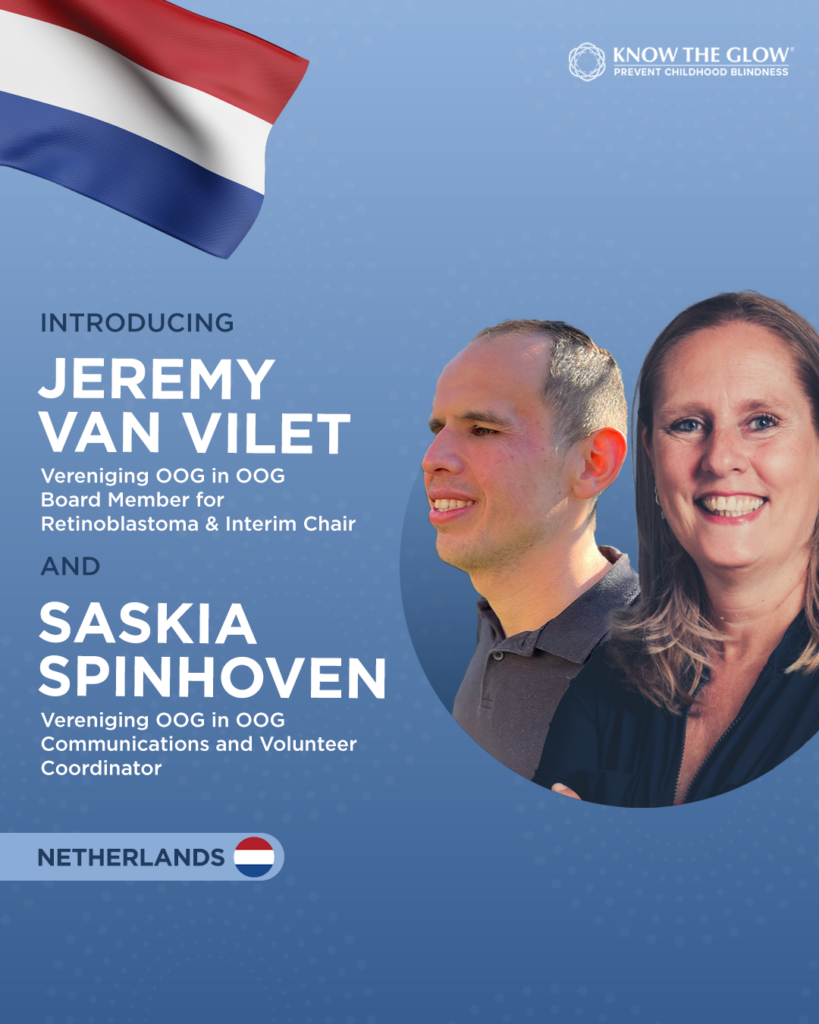
When Co-Founder Megan Webber and Director of Global Outreach Helene Dameris recently connected over Zoom with Vereniging OOG in OOG, a Dutch retinoblastoma patient society, the conversation quickly evolved beyond a simple organizational introduction.Vereniging OOG in OOG is dedicated to advocating for and supporting all people in the Netherlands who live with vision in only one eye and/or wear one or two ocular prostheses, helping them navigate daily life, access resources, and build a strong, connected community.
Joining the meeting were OOG in OOG Communications Officer Saskia Spinhoven and board member Jeremy van Vliet, a bilateral retinoblastoma survivor diagnosed at just three months old. What followed was a thoughtful exchange about survivorship, patient support, awareness, and the different ways families continue navigating the long-term impact of retinoblastoma well beyond treatment.
The Dutch Retinoblastoma Association (RBVN) recently became part of Vereniging OOG in OOG, a Dutch patient organization that has been supporting people with vision in one eye and individuals who wear one or two ocular prostheses since 1998. By joining forces, the organizations have strengthened their ability to advocate for and support a broader community, including retinoblastoma survivors as well as others affected by eye loss. During the conversation, Saskia and Jeremy shared how this integration is creating new opportunities to expand outreach, strengthen member engagement, and build on the foundation that OOG in OOG has developed over nearly three decades. They also highlighted the organization’s close relationship with Amsterdam UMC, home to the Retinoblastoma Center for the BeNeLux, which further strengthens collaboration between patient advocacy and one of Europe’s leading retinoblastoma treatment centers.
Their focus is increasingly centered on understanding what families truly need beyond medical care, including connection, peer support, buddy programs, and opportunities for smaller, more personal gatherings throughout the year rather than one large annual event. They also discussed the reality that retinoblastoma and vision loss often resurface emotionally and practically during major life milestones, creating new challenges for survivors and families long after treatment has ended.
Jeremy shared his own story during the discussion. Diagnosed as an infant after his parents noticed not a classic ‘glow’, but a strange reflective light in his eyes resembling the eyeshine of a cat, his diagnosis changed the course of his family’s life. Jeremy ultimately lost his right eye, and today retains approximately 10–16% vision in his left eye following radiation treatment.
Yet his story is not defined by limitation. Jeremy attended mainstream schools, briefly spent time in special education that ultimately was not the right fit, and successfully completed both primary and secondary school with the help of assistive devices. Today he lives what he describes as a very normal life, with a family and a career as a Customer Success Manager for a software company. Still, he felt drawn toward work with greater social impact, which ultimately led him to volunteer with OOG in OOG.
Jeremy also shared that prior to connecting with KnowTheGlow, he had not realized that The Glow could indicate conditions beyond retinoblastoma. Learning more about leukocoria and the broader mission behind KTG’s work gave him a new perspective on the importance of awareness and early detection.
One topic that resonated deeply throughout the conversation was genetics and the lifelong implications many survivors continue to face well into adulthood. Jeremy expressed interest in building more retinoblastoma-specific communities within the broader OOG in OOG structure. At the same time, both he and Saskia emphasized the importance of bringing together children who have lost an eye for many different reasons, recognizing that despite differing diagnoses, many share similar emotional and social experiences growing up.
Megan shared about WeC Hope, including the annual One RB Conference and the children’s camp they host each year, which brings children together regardless of how they lost an eye. Jeremy appreciated the inclusivity of that approach, noting how much overlap exists in the lived experiences of these children despite different medical circumstances.
Saskia explained that retinoblastoma outcomes in the Netherlands are exceptionally strong, with survival rates reaching 96-98%. Diagnosis and treatment are fully covered by the government, including the cost of prosthetic eyes. She also shared that enucleation has become less common than in previous decades due to advances in treatment. OOG in OOG works closely with Dr. Annette Moll, whom Megan had the opportunity to meet earlier this year in Brazil, and participates in the EURbG parent network across Europe.
Looking ahead, OOG in OOG is working to create a more interactive WhatsApp community for families, believing it may foster stronger ongoing communication and support than their existing Facebook group. The organization also hopes to facilitate more regular opportunities for families to spend time together and build lasting connections with others who understand their experiences.
For both organizations, the meeting reinforced something important: awareness alone is not enough. Families also need community. They need spaces where survivors can speak honestly about growing up with vision loss, where parents can ask questions about genetics and the future, and where children can simply feel understood.
As OOG in OOG looks toward its next chapter and KnowTheGlow continues building global awareness partnerships, both organizations left the conversation energized by a shared goal: ensuring that no family feels alone after diagnosis, treatment, or survivorship.