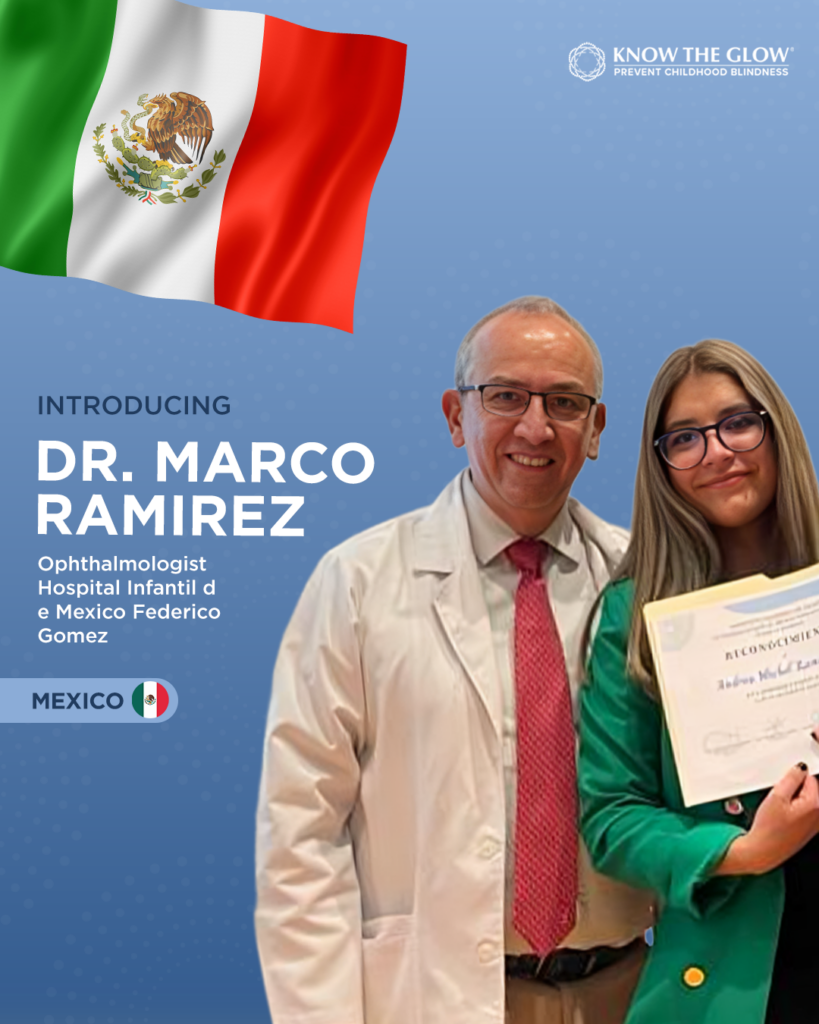
In a small, deeply connected global community of physicians working to treat retinoblastoma, certain names come up again and again. Not because they seek recognition, but because their work quietly shapes what becomes possible for children around the world.
As we began planning our awareness efforts in Mexico, one name surfaced repeatedly, Dr. Marco Ramirez. His reputation, his impact, and his longstanding role in advancing retinoblastoma care in the country all seemed to converge in a way that made it clear this was someone we needed to know. Megan Webber, Co-Founder of KnowTheGlow, was both delighted and honored when the opportunity arose to speak with him. In preparing for that conversation, she came to appreciate the threads that connect this field across generations, including his training under Dr. Linn Murphree, whose influence continues to shape retinoblastoma care around the world. What she didn’t expect, in speaking with Dr. Ramirez, was just how much of his story is about coming home.
In 2001, after the September 11 attacks, a quiet crisis unfolded for many undocumented families in the United States. Children who had been receiving care suddenly lost access to treatment, and for those with retinoblastoma, the consequences were immediate and severe. At the time, there was no physician in Mexico trained in modern retinoblastoma care. Dr. Murphree saw both the problem and the solution. If children could no longer remain in Los Angeles for treatment, then care needed to exist where they lived. After completing advanced training, including time at Johns Hopkins University and in Los Angeles, Dr. Marco Ramirez returned to Mexico with not only the knowledge but also the tools to begin building something that did not yet exist, becoming the very doctor who had been trained and sent home for that purpose. There was no system waiting for him, only the understanding that one needed to be created.
Today, Dr. Ramirez works at the Hospital Infantil de Mexico Federico Gomez, one of the country’s leading pediatric hospitals. Over the years, he has helped build a network of care across Mexico, expanding readiness centers, training physicians, and strengthening the pathway from diagnosis to treatment. But what stayed with Megan most from her conversation was not the scope of what he has built, but how he spoke about families. He described parents traveling hours, sometimes days, to reach care, often bringing other children with them because there is no one to leave them with. They return again and again for treatment, navigating costs that extend far beyond medicine. When he said, “I really admire these parents,” it was clear that his work has always been rooted in a deep respect for the people behind the diagnosis.
Over time, his role has extended far beyond the clinic. He has worked alongside organizations founded by parents who once sat where his patients’ families now sit, and he has supported communities like RetinoMX, where families share their experiences and, just as importantly, their hope. He remains closely connected to a global network of physicians and researchers, contributing to a growing body of knowledge and evolving approaches to treatment. And yet, he continually returns to something remarkably simple. If there is one goal he would prioritize above all others, it is the widespread use of red reflex examination, a quick and low-cost test that can detect retinoblastoma early, when outcomes are dramatically improved. In a field defined by complexity, his focus on simplicity feels both practical and profound.
When Megan asked what has meant the most to him over the years, his answer was immediate. His best reward is “seeing them”. Seeing them not just as patients, but as who they become. Children he once treated are now adults, pursuing university degrees, building careers, and living full, independent lives. Ten or fifteen years ago, that outcome was far less certain. Today, it is something families can begin to hope for, and in many ways, that shift is part of his legacy.
Dr. Ramirez did not set out with a clear plan to specialize in retinoblastoma. He was the first doctor in his family, and his path into this work began almost by chance, through a conversation that led to research, then training, and ultimately to a lifelong commitment to pediatric ocular oncology. It is striking to consider how many lives have been shaped by that moment, and how that decision has continued to ripple outward over time.
As we prepare to begin our awareness work in Mexico through KnowTheGlow, Megan was reminded that at KTG, our role is not to rebuild or replace what already exists, but to support it, to be a ribbon on the package he has already wrapped. The foundation is there in the form of trained physicians, equipped hospitals, and families who, despite everything, find their way to care. What awareness can do is help more families arrive earlier, before the disease advances and before options become limited.
After more than twenty-five years in this field, Dr. Ramirez has begun to look toward the future, to the physicians he has trained, the systems that will continue, and the patients who are now building lives of their own. What resonates most is not just the scale of what he has accomplished, but the consistency of it. The decision, made years ago, to come home and build something where nothing existed, and the lives that continue because he did.
Megan and the team at KnowTheGlow look forward to working with Dr. Ramirez and his team and hope to share some of the stories of the families he has impacted and the individuals and organizations that have made his work treating children with retinoblastoma possible as we continue our program of awareness for Dr. Ramirez’ home, Mexico.