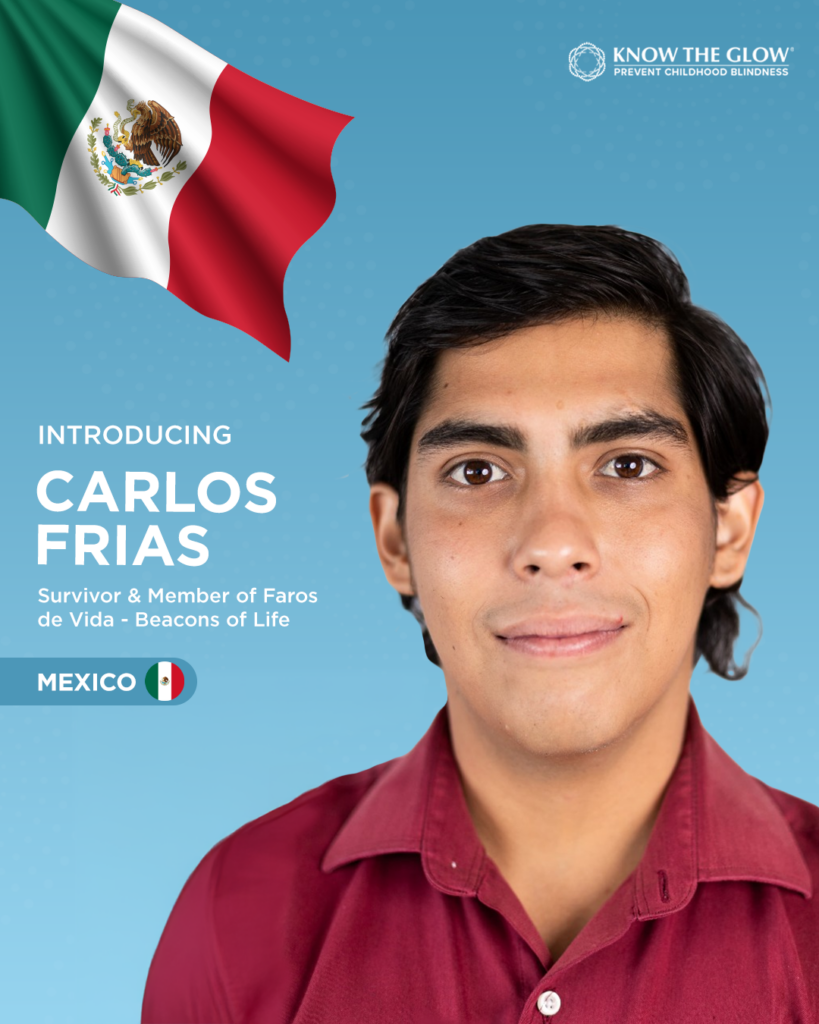
Megan Webber, Co-Founder of KnowTheGlow, and Helene Dameris, Director of Global Outreach, reached out to Carlos Frías after seeing that Childhood Cancer International (CCI) had listed him as part of the steering committee for survivors. What followed was a conversation with a remarkable young man from Guadalajara, Mexico, whose personal journey with acute lymphoblastic leukemia, diagnosed when he was just seven years old, has become the foundation for a life devoted to advocacy and support for others.
Carlos was only seven years old when he was diagnosed with leukemia. His treatment lasted until the age of eleven, and throughout this difficult period he and his family were supported by CANICA, the childhood cancer association founded by Javier Galván. Carlos remembers programs like My Great Hope and My Last Wish, (“Mi gran Esperanza” and “Mi ultimo deseo”) but most of all he remembers the psychological support that made it possible for his family to endure. This foundation of care became the reason he later returned to CANICA.
By the age of thirteen, Carlos was no longer a patient, yet he felt compelled to remain close to the organization that had carried him through his darkest years. He began volunteering, using his own experience to connect with children in treatment and their families. Through his teenage years, he became a steady presence in the CANICA community, offering comfort, perspective, and hope.
In 2020, he joined CANICA officially, taking on the challenge of fundraising and creating new ways to sustain its programs. At the same time, a wider conversation was taking place within CCI LATAM, where Javier Galván and Dra. Marcela Zubieta recognized that survivors were not receiving the long-term care they needed. Carlos was invited to be part of a pioneering group of eight young survivors from across Latin America who came together to form Faros de Vida, or Beacons of Life. Their aim was to create a dedicated space for survivors to be heard and supported.
The group listened to survivors across the region and found that the challenges extended beyond treatment. Many spoke of lingering struggles with mental health and the lasting effects of chemotherapy. Others described how difficult it was to maintain healthy routines when all they wanted was a sense of normal life. Discrimination in public policy and access to financial services emerged as a major obstacle for many, and there was also a strong desire for better information about the long-term medical impact of treatment. These insights shaped the model that Faros de Vida has now brought to life.
To address these concerns, Carlos and his colleagues built a structure of mentorship, education, and advocacy. They formed alliances with Together by St. Jude’s, PAHO, CCI LATAM, CCI Global, and SIOP to ensure that the work was informed by best practices and the latest knowledge. Survivors who wish to support families are trained before they ever sit down with a child or parent. Workshops and lectures provide them with the tools to offer guidance that is safe, compassionate, and meaningful.
Faros de Vida now has national representatives in twelve countries, each working closely with local CCI networks. Survivors meet to share experiences and to learn from experts on subjects that touch every aspect of survivorship. The full model launched this June and stands as the first of its kind anywhere in the world.
Carlos often describes the effort as a crazy idea that has only been possible because so many others believed in it too. In partnership with PAHO, Faros de Vida ensures continuity of care so that once a child has been cancer-free for two years, they are welcomed into a supportive community that helps them navigate the future. This approach gives families time to breathe while also providing assurance that they will not face survivorship alone.
As he looks ahead, Carlos hopes to secure independent funding so that Faros de Vida can sustain and expand its work. His vision is one of empowerment and dignity for every survivor. In many ways, Carlos himself is the embodiment of the name he chose for the organization. He is a beacon of life, illuminating a path for others to follow, and his journey from a child in treatment to a leader in advocacy is already changing the future of survivorship across Latin America.