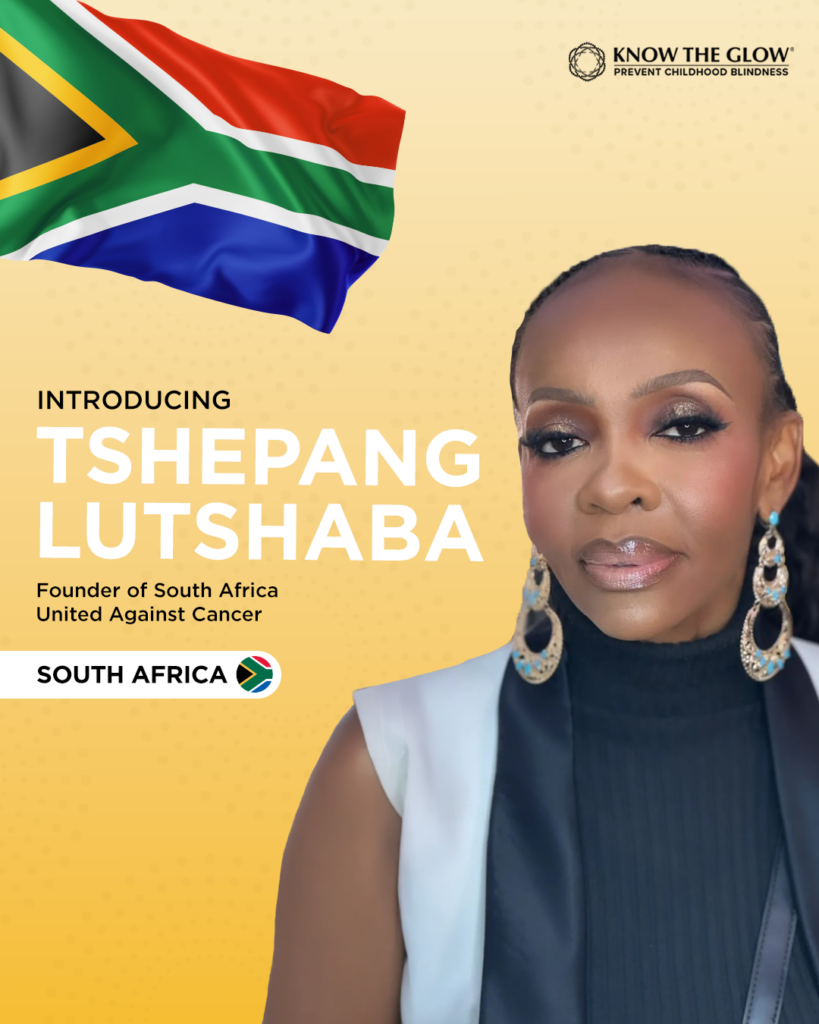
Recently, Know The Glow Program Manager for Africa, Ruth Ngaruiya, connected with Tshepang Lutshaba to learn more about the work behind South Africa United Against Cancer, an organization Tshepang founded eight years ago out of personal loss and purpose.
Tshepang Lutshaba’s commitment to cancer advocacy began with personal loss. After losing her grandmother and aunt to cervical cancer, and later a stepsister to breast cancer, she came face to face with the devastating realities of cancer within her own family. These losses shaped a mission that has now spanned nearly a decade: to raise cancer awareness and support patients, particularly in South Africa’s rural communities, through South Africa United Against Cancer (SAUAC).
The organization was born to address a critical gap in knowledge and support. In many rural areas and Townships, cancer is still misunderstood, often attributed to witchcraft or spiritual forces leading to delayed medical care, stigma, and family conflict. Tshepang recalls her aunt expressing deep regret that she had not been able to educate others about cancer before she passed away. Today, that experience shapes SAUAC’s work. The organization runs community education programs, survivor support groups, and outreach initiatives in collaboration with the Department of Health, helping individuals navigate diagnosis, treatment, and emotional recovery.
Much of Tshepang’s work takes her into communities where a cancer diagnosis can mean isolation from the very support systems people rely on. She educates communities about different types of cancer, symptoms, and the importance of early detection, but she also focuses on something just as vital: connection. Through survivor support groups, she creates spaces where people can speak openly, engage with healthcare professionals, and remind one another that they are not alone. A significant part of her outreach also happens in schools, where she brings cancer awareness directly to young people, equipping them with knowledge they can take home to their families.
This work has come at a personal cost. Funding is often limited, and the emotional toll is heavy. There have even been moments when those closest to her questioned why she continues. Through it all, Tshepang says her faith has carried her, grounding her in the belief that the work matters.
The cultural barriers Tshepang encounters in cancer awareness mirror those faced in childhood eye cancers such as retinoblastoma. During the conversation, Ruth shared that Know The Glow has seen similar patterns across other African countries, where a white glow in a child’s eye is sometimes interpreted as a spiritual sign rather than a medical warning. In both cases, traditional healers are often the first point of contact, and by the time families reach medical facilities, it can be too late.
In high-income countries, survival rates for retinoblastoma approach nearly one hundred percent. In many parts of Africa, they remain closer to thirty percent. This gap is not primarily about access to medicine, it is about awareness and treatment abandonment.
As the conversation came to a close, Tshepang reflected on why she continues this work. She believes in what she is building: a network of support, a source of reliable information, a future where no adult dies from a preventable cancer, and no parent has to watch a child suffer from a condition that could have been treated if the signs were recognized early. With Know The Glow joining this effort in South Africa, that future feels a little closer. Both organizations plan to continue engaging and amplifying awareness together in the months ahead.