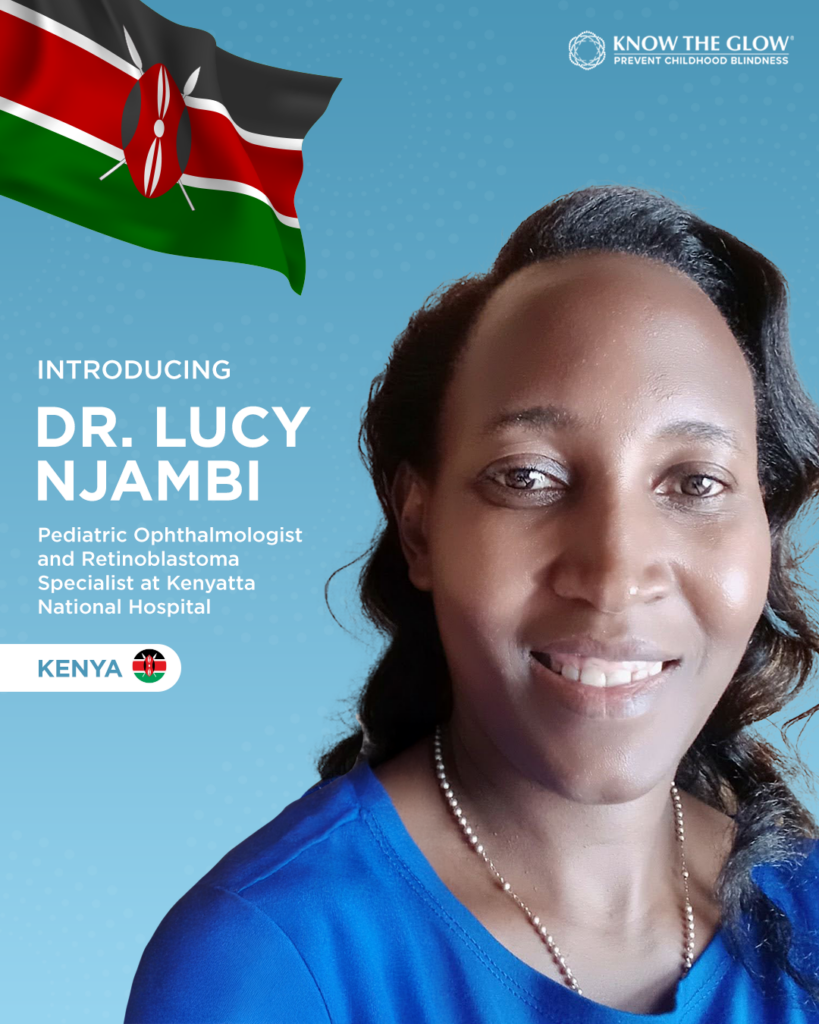
Megan Webber, Co-Founder of the nonprofit KnowTheGlow, expressed her honor at finally connecting with Dr.Lucy Njambi, a pediatric ophthalmologist and retinoblastoma specialist at Kenyatta National Hospital. Their meeting was facilitated by Ruth Ngaruiya, KnowTheGlow’s Program Manager in Africa, and included Helene Dameris, the organization’s Director of Global Outreach. The purpose was to exchange perspectives and identify practical ways to expand awareness and ensure more children are diagnosed and treated early in Kenya.
Dr.Lucy Njambi shared insights into her work in pediatric ophthalmology and retinoblastoma genetics in Kenya. Her journey began almost by chance, when she and a friend decided to apply for medical school without much thought. Motivated by a desire to prevent avoidable blindness, she specialized in pediatric ophthalmology. She saw the overwhelming burden of retinoblastoma care falling on some of her colleagues like Dr.Kahaki , and chose to specialize in the disease, training in Toronto to help build local capacity. Over the past decade, through dedication and strong international collaboration, the survival rate for retinoblastoma in Kenya has dramatically improved from 26% to nearly 70%.
Despite this progress, Dr.Njambi highlighted the persistent, heart-wrenching challenge of late diagnosis. She recounted a recent case of twins where one child’s symptoms were repeatedly dismissed by healthcare workers until the disease was fatal. Tragically, the second twin, who showed no visible symptoms, was also found to have bilateral retinoblastoma. This case highlighted the importance of ongoing education for both the public and frontline health workers. The national maternal and child health booklet already provides guidance on eye checks, and building on this foundation with more targeted training can help ensure children are identified and treated as early as possible.
Dr.Njambi strongly believes that awareness is key to preventing late-stage presentations of retinoblastoma. When communities are informed about the disease, parents are more likely to recognize early warning signs and consent to genetic testing for their children. Understanding inheritance patterns is not about assigning blame to anyone but about equipping families with knowledge to protect future generations. She highlighted the role of awareness campaigns, such as those led by KnowTheGlow, in reducing fear and stigma, promoting early screening, and helping children access timely treatment.
The conversation then turned to the future: genetic research. Dr.Njambi is the principal investigator on a groundbreaking grant from the SickKids Centre for Global Child Health in Toronto, running from 2023 to 2027 working together with Dr.Helen Dimaras. The project aims to build molecular cancer research capacity in Kenya using retinoblastoma as the model. It is a multidisciplinary effort involving the University of Nairobi’s departments of Ophthalmology, Pathology, and a clinical research institute where the genetic sequencing is performed. The goal is to establish local, sustainable genetic testing so families no longer need to send samples abroad. This allows for faster results and builds expertise for future genomic research. The team has already sequenced 70 samples and is training the next generation of scientists through PhD and MSc programs.
Dr.Njambi also discussed the challenges of implementing genetic research. Collecting family histories can be difficult in parts of Africa where many cases go undocumented and access to modern medical care is limited. Early detection is already challenging, and additional barriers often prevent children from reaching care.
She explained the complexity of genetic testing for retinoblastoma. Some cases cannot be resolved with a single test, requiring next-generation sequencing and additional investigations due to the nature of the mutations. While current testing represents a strong foundation, further research is needed to integrate findings into routine clinical practice. Dr.Njambi emphasized that collaboration and commitment from all team members are essential, and even small contributions from dedicated staff and students can have a meaningful impact on advancing research and improving outcomes for children.
Dr.Njambi highlighted the need for additional partnerships to continue advancing research and patient care. She emphasized the importance of working with committed professionals and noted that volunteers who engage in complex and overwhelming conditions like retinoblastoma are particularly valuable. Looking ahead, she stressed that sustaining progress, securing further funding, and translating genetic research into clinical practice as well as more awareness are essential for improving outcomes for children affected by retinoblastoma in Kenya.