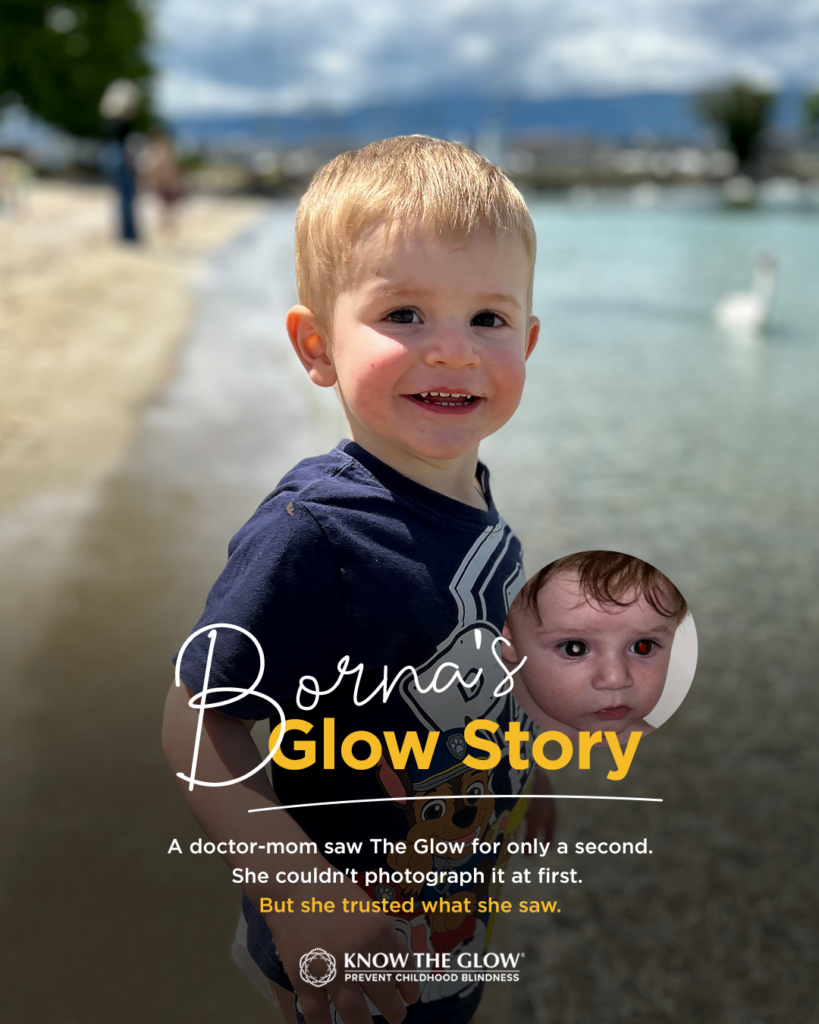
Written by his mother, Nina Barać
Borna was born a healthy baby boy. When he was 4 months old, during bath time, I noticed a strange glow in his right pupil, but only when he looked to one side. I was bathing him with a golden cup, and my first thought was that it might simply be a reflection of the cup. Still, deep down, I was terrified because I knew about the white glow (leukocoria) that can be a sign of retinoblastoma.
I immediately took him into a dark room and shone the flashlight from my phone into his eyes. I only saw a normal red reflex, which was reassuring. I even sent the photos to my friend, an ophthalmologist, who confirmed that the red reflex looked completely normal. At that point, I still hadn’t managed to capture the white glow on camera.
The following day, while we were in the elevator, Borna was lying in his stroller when I saw it again. It lasted only a second and only appeared when he looked in a certain direction. I would describe it as a “cat’s eye” reflection. I was shocked. Once again, I tried to photograph it, but I couldn’t.
That evening, during bath time in the same position, I finally managed to capture the white glow in a photograph. We immediately rushed to the ophthalmology emergency department. The doctors noticed something abnormal but wanted a senior ophthalmologist to examine him before making a diagnosis.
Two days later, our lives changed forever.
We are from Croatia, where Borna underwent an urgent MRI that revealed an 8 × 6 mm retinoblastoma lying against the optic nerve, fortunately without invading it. He also underwent a lumbar puncture and bone marrow aspiration, both of which thankfully showed no evidence of metastatic disease.
Borna received systemic chemotherapy in Zagreb before being referred to Switzerland, where he underwent intra-arterial and intravitreal chemotherapy. Thankfully, the tumor responded very well, shrinking significantly and becoming almost completely calcified.
Six months later, however, the tumor started growing again. He received additional intravitreal chemotherapy combined with laser treatment, which successfully controlled the recurrence.
Today, Borna has been stable for one year and three months. His tumor is now completely calcified, leaving only a scar from the inferonasal retinoblastoma.
As both a mother and a medical doctor, I truly believe that maternal intuition is something we still cannot fully explain. Because I knew the warning signs, we were able to act immediately. I will always encourage parents: if you notice or feel that something isn’t right with your child, trust your instincts and seek medical attention. Early detection can preserve vision—and sometimes even save a child’s life.
Today, Borna is a thriving two-year-old, full of life, curiosity, and endless energy. Despite chemotherapy, countless hospital visits, and months of treatment, none of it has defined him. He has an older brother, just 18 months older, and honestly, there is no difference between them. Borna wears an eye patch over his healthy eye for six hours every day to strengthen the vision in his affected eye. His vision has improved from being very limited to becoming highly functional. He rides his bike, climbs playgrounds, attends nursery, and does it all while proudly wearing his eye patch. He is our little superhero.
Genetic testing showed that Borna does not carry an RB1 mutation. Interestingly, after his diagnosis, we learned that a distant relative in our family had also been treated for unilateral retinoblastoma without an identified RB1 mutation. We had never known about her before. Because of this unusual family history, geneticists continue to follow our case closely.
We are so grateful to all the doctors and nurses who cared for Borna throughout his journey. We would especially like to express our deepest gratitude to Dr. Christina Stathopoulos at Hôpital Ophtalmique Jules-Gonin in Lausanne, Switzerland. Her exceptional expertise, dedication, and compassion made an immeasurable difference throughout Borna’s journey. We will always be profoundly grateful to her, as well as to the entire team at Jules-Gonin Hospital, for the outstanding care they provided to our son.
One important thing I would also like to mention is that we still occasionally see the same white glow in Borna’s right eye. This can be frightening for people who know about leukocoria, but in his case it is simply a reflection from the calcified scar tissue left after successful treatment rather than active disease.
If sharing Borna’s story helps even one family recognize the signs of retinoblastoma earlier and seek medical attention without delay, then every word is worth it.
To every parent reading this: trust your instincts. You know your child better than anyone else. Sometimes, noticing something that lasts only a second can change everything. In Borna’s case, it led us to seek medical attention without delay, allowing treatment to begin as early as possible.