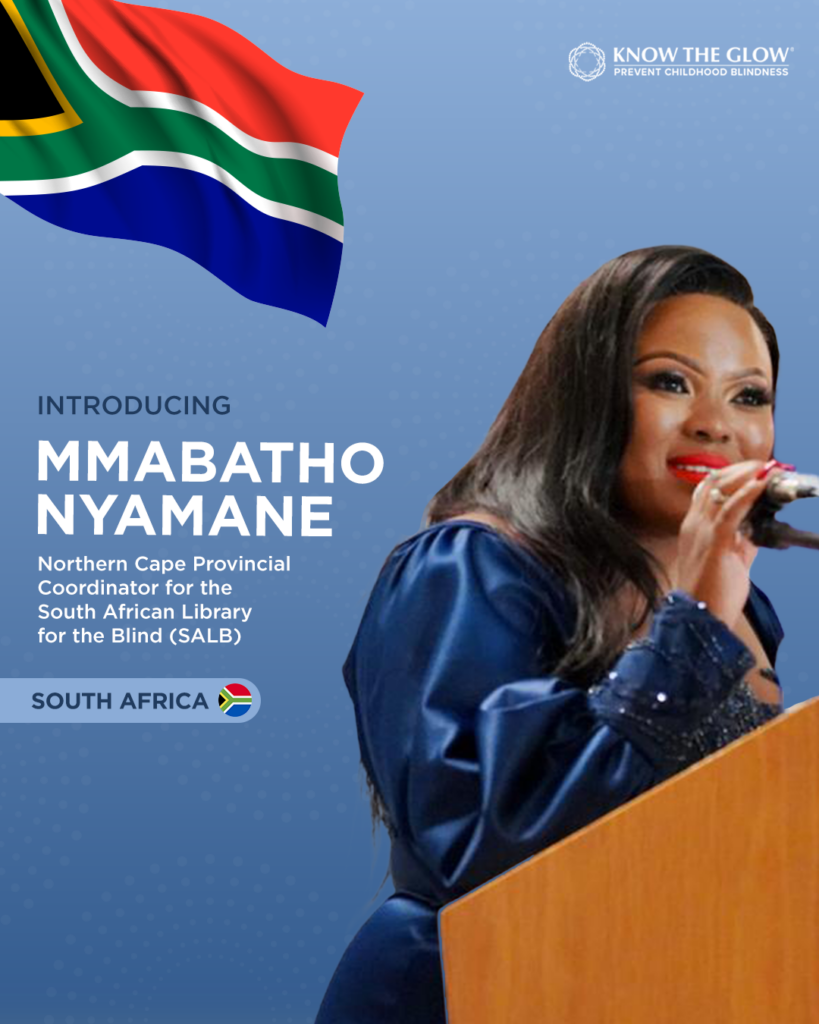
Ruth Ngaruiya, Programs Manager for KnowtheGlow in Africa, recently connected with Mmabatho Nyamane, Northern Cape Provincial Coordinator for the South African Library for the Blind (SALB), to explore how awareness, education, and access intersect for children with visual impairment.
Soon after introductions, Ruth and Mmabatho realized how much their work overlaps. KnowtheGlow focuses on helping parents spot the early signs of childhood glow-related eye conditions, while SALB ensures that anyone who loses their sight can continue to learn, be creative, and live independently.
Mmabatho shared her personal motivations for working in the nonprofit sector, driven by her family’s experiences with blindness and her own corneal condition. She spoke about her work leading the Mini Library Project, which provides visually impaired individuals with books and educational resources in Braille, audio, tactile and large-print formats. But the work doesn’t end at the library. Her team conducts extensive community outreach, door-to-door campaigns, partnerships with clinics, and collaboration with municipalities, navigating rural logistics to locate children who have been hidden away or overlooked by the educational system.
She recalled discovering a ten-year-old girl who had never been enrolled in school. “That honestly brought so much joy to my heart,” Mmabatho said. “To have a child that can actually be a child.” She was placed in a supportive school environment, the girl thrived so fully that she was reluctant to return home for holidays.
SALB’s mini library services are offered free of charge to registered members, but their impact goes beyond access to books. Librarians undergo customer care training to ensure visitors are supported with patience and understanding. The libraries also provide assistive device training and guidance on using technology like DAISY players and the solar-powered Envoy Connect, a portable device designed for rural areas with limited electricity.
Traditional media channels and social media play a key role in SALB’s outreach. They share stories of members’ achievements widely to inspire others and raise awareness about visual impairment. SALB also holds workshops, literacy programs, and community events that support self-reliance while helping communities better understand blindness. SALB encourages creativity and confidence among its members through braille classes, orientation and mobility training, and participation in national literacy competitions. Some members have even had their poetry and short stories published in a book titled: Now You See Me.
“We try to make learning fun,” Nyamane shared, pointing to initiatives such as Dine in the Dark dinners, White Cane Day walks, where staff themselves participate blindfolded, and school programs held during International Literacy Day. Together, these activities educate, and foster a better understanding of visual impairment within the community.
Despite its successes, SALB faces systemic challenges. Many families rely solely on public healthcare, where access to specialists and treatment is limited. The organization receives funding from the Department of Sports, Arts, and Culture, but costs for assistive devices remain high, and outreach requires constant resources. Social grants for the unemployed provide some support, but they are minimal. Despite these constraints, the organization continues to expand programs, reach new members, and provide innovative solutions to ensure no child or adult is left behind.
Looking ahead, both organizations are committed to sharing the stories of children and individuals who are thriving despite early vision loss, reminding families that blindness does not define a person’s potential. Through these stories, they hope to encourage parents to seek early checkups and timely treatment, enroll their children in school, and focus on possibilities rather than limitations.